Select a site alphabetically from the choices shown in the box below. Alternatively, browse sculptural examples using the Forward/Back buttons.
Chapters for this volume, along with copies of original in-text images, are available here.


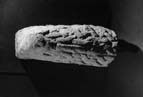
Object type: Part of hogback [1]
Measurements: L. 42.3 cm (16.7 in) W. 18.1 cm (7.2 in) H. 34.5 cm (13.5 in)
Stone type: As Pickhill 1(All Saints) except that there is more limonite content, and bedding planes are prominent parallel to the front and back edge.
Plate numbers in printed volume: Ills. 739–42
Corpus volume reference: Vol 6 p. 193-194
(There may be more views or larger images available for this item. Click on the thumbnail image to view.)
A plain ridge issues from the end-beast's jowl but does not stand proud.
A (long) : Below the ridge is a horizontal run of three-cord plain plait, four stages surviving. The roof pitch is steeply curved. The side, now vertical, is very damaged.
B (end) : The end-beast is very small with a pointed head: it is difficult to decipher its features. Traces of a hind leg remain.
C (long) : Damaged but as face A.
D (end) : Lost.
This is a type f (vestigial) hogback, its puny end-beast a very rudimentary animal. It is usually only poorly carved end-beasts which have four legs. Collingwood'suggested that there might be a row of tegulae below the plait, which would be most unusual.
