Select a site alphabetically from the choices shown in the box below. Alternatively, browse sculptural examples using the Forward/Back buttons.
Chapters for this volume, along with copies of original in-text images, are available here.


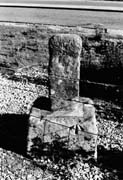
Object type: Shaft fragment and socket (the 'Rey' or 'Rere Cross')
Measurements:
Shaft: H. 73 cm (28.7 in) W. 30.5 > 28.5 cm (12 > 11.2 in) D. 26.5 > 19 cm (10.4 > 7.5 in)
Socket: H. 42 cm (16.5 in) W. 69 cm (27 in) D. 65 cm (25.5 in)
Stone type: Medium-grained deltaic sandstone with sub-angular grains. Very pale brown (10YR 7/4). Very local in origin; sandstone of the Main Limestone cyclothem, Namurian, Upper Carboniferous
Plate numbers in printed volume: Ills. 1154–6, 1162–3
Corpus volume reference: Vol 6 p. 283-284
(There may be more views or larger images available for this item. Click on the thumbnail image to view.)
The shaft is rectangular in section, but indented near the top with a shallow depression on all four faces. The original south face (face C) has been cut away at the top. The surfaces are plain, with no evidence of edge mouldings.
Appendix A item (stones dating from Saxo-Norman overlap period or of uncertain date).
Collingwood identified this as part of a pre-Conquest cross, of which 'the neck and lower part of a wheel-cross head seem to be visible' (in Calverley 1899, 264). Bailey could find no such traces recently, preferring to see the nipped neck and surmounting swelling as 'a phallic-like form' (Bailey n.d.), though he suggests that the shaft may be inverted, with the uncarved portion now uppermost (op. cit.).
At the bottom of the original west face (face B) Collingwood'saw 'forms too regular for mere weathered roughness', which he interpreted as 'a rudely hacked pattern of diverging straps with pellets'. Such traces if they ever existed have since eroded away (Ill. 1155).
The features which Collingwood recorded would be typical of Anglo-Scandinavian sculpture in Cumbria and northern Yorkshire, and he compared the forms on the western face with carvings at Beckermet St John and Burton in Kendal (Calverley 1899, 264; cf. Bailey and Cramp 1988, 57–61, 82–4). An Anglo-Scandinavian shaft not far distant on Dere Street, the Legs Cross (Cramp 1984, 122, pls. 108–9), also served as a marker on a hill crest by the side of a Roman road. Ekwall suggested that the name Rey or Rere derives from Old Scandinavian hreyrr, 'cairn', an element used in modern Swedish in the sense of a boundary-mark (Smith, A. 1928, xlvi). It was in the vicinity of the Rey Cross location that Eric Bloodaxe was assassinated on Stainmore in 954 (Luard 1890, 503; Calverley 1899, 266–8).
The shaft's function was very likely to mark a territorial boundary: in 1258 the Bishop of Glasgow regarded the 'Rer Cros in Staynmor' as the limit of his diocese (Stevenson 1839, 65), and various other medieval sources confirm the Rey Cross as the meeting point of Scottish Cumbria and England (Boethius 1527; Holinshed 1587; Skene 1867; Fordun 1871; Bain 1884; Bain 1887; Wyntoun 1906; Wilson, J. 1915; Anderson 1973; Bower 1989). In 1611 Speed described a stone cross with carvings on opposite sides of the shaft which he interpreted as images of the English and Scottish kings. One can only assume that these early references apply to the present relic.
