Select a site alphabetically from the choices shown in the box below. Alternatively, browse sculptural examples using the Forward/Back buttons.
Chapters for this volume, along with copies of original in-text images, are available here.


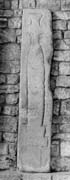
Object type: Grave-cover
Measurements: L. 206 cm (81 in) W. 42 > 37 cm (16.5 > 14.5 in) D. 8 cm (3.1 in)
Stone type: Coarse deltaic sandstone (probably gritstone), feldspathic, sub-angular grains, well sorted. Millstone Grit? (Namurian, Upper Carboniferous), local to the Romaldkirk village site
Plate numbers in printed volume: Ill. 1183
Corpus volume reference: Vol 6 p. 284
(There may be more views or larger images available for this item. Click on the thumbnail image to view.)
A plain flat slab, its long sides uneven, with an incised outline cross on a stepped base in the centre. The cross-head is of type C10 with broad curved armpits and chamfered arms, and the centre of the shaft is swollen, tapering at either end. The base has two steps. The cross, shaft and base are outlined with broad pecked grooves, now partly eroded.
Appendix A item (stones dating from Saxo-Norman overlap period or of uncertain date).
Large-scale slabs with simple incised crosses such as this are difficult to date out of context. There is a change of scale from something like the pre-Conquest grave-covers from York or Lincoln (see Lincoln St Mark 13: Everson and Stocker 1999, ills. 253, 254) to post-Conquest covers in which the stemmed crosses are in relief. The head form could be pre-Conquest, and stepped bases are more usually, but not invariably, found on post-Conquest monuments (Bailey and Cramp 1988, 163), but on the whole the closest likeness to this piece is to be found in the cross forms on a group of slabs in southern Scotland, from Ardwall and Anwoth in Galloway (Thomas 1967, 151, fig. 30). The long-stemmed crosses there are not depicted with bases, but they have the swollen stem which is also distinctive of the Romaldkirk piece.
