Select a site alphabetically from the choices shown in the box below. Alternatively, browse sculptural examples using the Forward/Back buttons.
Chapters for this volume, along with copies of original in-text images, are available here.


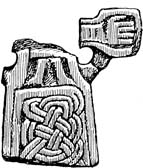
Object type: Part of cross-shaft and -head
Measurements: H. 41 cm (16.1 in) W. 32 > 28.5 cm (12.6 > 11.2 in) D. 17.5 cm (6.9 in)
Stone type: Very coarse limonitic Millstone Grit, angular grains in well sorted matrix. Very pale brown (10YR 7/3), with yellow (10YR 7/8) flecks and patches. Probably Red Scar Grit (Namurian, Upper Carboniferous), commonly found capping the hills on the western margins of Wensleydale.
Plate numbers in printed volume: Ills. 788–92
Corpus volume reference: Vol 6 p. 209-210
(There may be more views or larger images available for this item. Click on the thumbnail image to view.)
A (broad) : The edge moulding is worn. Within it is a second moulding, also 1 inch wide. The neck narrows to accommodate the type 1a ring which survives only as stumps at each side. The arm-pits within the ring were circular, though the cross is of type B10. Within the neck of the shaft is a central triangle flanked by plain diagonal broad strands. Below is a framed panel of median-incised strand interlace: the terminal of a pattern F loop with added diagonals, of which Collingwood noted 'the want of sequence in the plait' (1907, 402). The missing arm (ibid., fig. d) contained a large spread hand that filled the panel.
B (narrow) : The edge moulding is worn. The panel contains a four-cord plait in modelled strand, 1 inch wide like the edge moulding.
C (broad) : The edge moulding is like face A's, and the neck has an identical motif to that on face A. The inner edge moulding frames closed circuit interlace in broad median-incised strand, in a disorganised three-cord plait.
D (narrow) : The edge moulding is that of the other faces. The panel contains a disorganised four-cord plait.
All the cutting is hacked work and the interlace is unplanned. The lost arm resembled the fashion of the two crosses at Thornton Watlass (Ills. 812, 813) in having disproportionately large hands for Christ. Collingwood's drawing of the triangular feature in the lower limb conveys the impression of legs astride and with splayed feet; there is no sign of feet today. The ring-head is an indication of a Hiberno-Norse milieu (see Chap. IV, p. 26).
