Select a site alphabetically from the choices shown in the box below. Alternatively, browse sculptural examples using the Forward/Back buttons.
Chapters for this volume, along with copies of original in-text images, are available here.


Object type: Shaft fragment
Measurements: H. 16.8 cm (6.6 in) W. 25.3 > 21.7 cm (10 > 8.5 in) D. 11 cm (4.3 in)
Stone type: Medium-grained, slightly micaceous sandstone, with very angular grains and well sorted fabric. Brownish yellow (10YR 6/6). Brigantian sandstone (Lower Carboniferous) from the vicinity of Thornton Steward village (a building stone in common usage in older buildings there).
Plate numbers in printed volume: Ills. 793–6
Corpus volume reference: Vol 6 p. 210
(There may be more views or larger images available for this item. Click on the thumbnail image to view.)
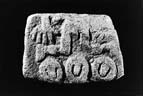
A (broad) : There is no edge moulding. At the top of the panel is a knock-kneed kneeling figure. It is phallic, with large splayed dangling hands and splayed feet. Below are three heads in line, with deeply incised facial features consisting of drilled dots for eyes joined by a U for the nose.
B (narrow) : There is no edge moulding, only remains of a run of scrolls, with two spirals linked by a loose loop in narrow strand.
C (broad) : There is no edge moulding. At the left are the trunk and legs of a standing phallic figure; one foot also survives. His left arm extends to grasp a snake which loops on the right-hand side.
D (narrow) : There is no edge moulding, only a tight run of scrolls, one with a central pellet, in narrow strand.
It is very rare to find phallic figures in the pre-Conquest carvings of Northumbria, though see also Masham 3 (Ills. 646, 648) which may be by the same hand. The combat with the serpent should be compared with the Cumbrian monuments Gosforth 5 and Great Clifton 1 (Bailey and Cramp 1988, 106–8, 110–11, ills. 323, 327, 329, 335, 336), as well as North Otterington 1 and 2 (Ills. 691, 692). However, since the figure contends with a solitary snake on this monument, it is possible that it represents Thór's combat with the world serpent at Ragnarök. The predilection for serpents recurs on Masham 3, which has, alongside Coverham 1 (Ill. 125), the same trick of depicting facial features, a mark of the Lower Wensleydale workshop (see Chapter VI).
