Select a site alphabetically from the choices shown in the box below. Alternatively, browse sculptural examples using the Forward/Back buttons.
Chapters for this volume, along with copies of original in-text images, are available here.


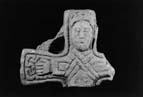
Object type: Part of cross-head [1]
Measurements: H. 40 cm (15.7 in) W. 43.2 cm (17 in) D. 11.5 cm (4.5 in)
Stone type: As Thornton Steward 2 (St Oswald)
Plate numbers in printed volume: Ills. 801–5
Corpus volume reference: Vol 6 p. 211-212
(There may be more views or larger images available for this item. Click on the thumbnail image to view.)
A (broad) : The remains of a type 1a ring survive on the left-hand side of the cross, whose arm-pits are wide curves of type 10. The upper limb has straight sides and tip, whilst the lateral arm expands into a slightly convex tip. The edge moulding is modelled and contains a Crucifixion, only the upper half and one arm surviving. The oval head fills the upper limb in quite high profile with modelled features. Above the head is a central loop flanked by two pairs of volute scrolls rising upwards. The hair or nimbus is a modelled strand. Christ is clothed in a tunic which has a cuff line at the wrist and an incised rectangle on each sleeve; the neckline consists of a bold saltire of two interlaced strands which terminate at the cross's arm-pits. The hand is spread and in proportion with the rest of the figure. Around the hand is a bent meander that serves as a filler.
B (narrow) : Broken away.
C (broad) : The edge moulding is narrow and modelled. The upper limb and centre of the cross is filled by a seated Christ in Majesty; over his head a worn meander fret filler in thin strand. Christ's head is in high relief and has a shallow nimbus. The features are crudely incised (recut?). The shoulders are rounded. The left hand lies in his lap, possibly holding something. The right arm is raised from the elbow in blessing. Vertical drapery folds fall from the knees. To the left of the figure is a vertical bar on which his hand rests, beyond which are two large pellets, one above the other. Two more block the cross-arm panel, which at the tip contains loose meander fret filler elements in narrow strand. Between the pellets and the filler is a pair of small seated figures in profile, facing each other. Their arms are bent at the elbows and their faces and toes touch.
D (narrow) : Within the modelled edge moulding is a panel of disorganised interlace.
E (top) : Damaged.
This wheel-headed cross must date from the period of the Hiberno-Norse colonisation of this region. The ring-head is diagnostic of that period (see Chap. IV, p. 26) and not only is the Crucifixion in the Irish position on the cross-head but the reverse face has a Christ in Majesty or Judgement scene in the manner of many Irish high crosses. The portrait carving is very plastic: modelled and standing in relief, unlike most crosses in the region at this period. A further Celtic trait is the pair of confronting seated figures who may well be SS Paul and Anthony, the founders of monasticism in the desert. This is a common motif in Ireland: for example, the cross of SS Patrick and Columba at Kells, Co. Meath, where the scene occurs in exactly the position as at Thornton Steward, on the lateral arm (Henry 1964, 42; Harbison 1992, I, 109, II, fig. 346). It also occurs in some Manx and Pictish contexts (Allen and Anderson 1903, 288–9; Kermode 1907, 138–9), though the triplet of images on this piece and its form strongly suggest an Irish source.
