Select a site alphabetically from the choices shown in the box below. Alternatively, browse sculptural examples using the Forward/Back buttons.
Chapters for this volume, along with copies of original in-text images, are available here.


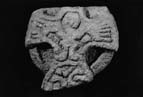
Object type: Part of cross-head
Measurements: H. 32 cm (12.6 in) W. 39.5 cm (15.6 in) D. 14.5 cm (5.7 in)
Stone type: As Thornton Steward 1 (St Oswald)
Plate numbers in printed volume: Ills. 807–11
Corpus volume reference: Vol 6 p. 212
(There may be more views or larger images available for this item. Click on the thumbnail image to view.)
A (broad) : A plate-head cross with splayed lateral limbs and arm-pits of type B10. The narrow edge moulding is rolled. The face shows a Crucifixion. The figure is short, the head and feet not extending into the longitudinal arms. The feet are apart with the toes turned out, the head pear-shaped with worn drilled features. The tunic has a short skirt. The hands are huge with splayed fingers. Beneath each arm is a pellet filler, 1 inch wide. Beneath the feet is a narrow curved moulding, below which the shaft contains loose kidney-shaped elements forming a Y motif. The rim of the plate is raised and has a bevelled edge.
B (narrow) : The arm-tip has a modelled moulding, 1 inch wide, containing a panel with four irregular pellets.
C (broad) : There is a narrow rolled edge moulding, as on face A. At the centre of the cross is a crude ring boss surrounded by a grooved moulding, flattened on its lower edge. The side arms are divided up into irregular pellets. In the lower arm are four C-shaped elements, the lower two addorsed. The upper part of the shaft is damaged. The rim of the plate is as on face A.
D (narrow) : Rough broad strand elements meet the plate rim. The arm-tip has a rectangular panel with a worn bar and pellet.
The plate-head form is common in the area (see Chap. V, p. 26) and the robed Crucifixion on the cross-head indicates a Hiberno-Norse milieu. The large hands should be compared with Thornton Watlass 1 and 2 nearby (Ills. 812, 813). The irregular pellets are reminiscent of the primitive decoration on Kirby Hill 5 and Wath 2 (Ills. 355, 852).
