Select a site alphabetically from the choices shown in the box below. Alternatively, browse sculptural examples using the Forward/Back buttons.
Chapters for this volume, along with copies of original in-text images, are available here.


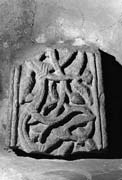
Object type: Shaft fragment [1]
Measurements: H. 30 cm (11.8 in) W. 26 > 23 cm (10.2 > 9.1 in) D. 13 > 12.5 cm (5.1 > 4.9 in)
Stone type: Medium-grained feldspathic Millstone Grit; very pale brown (10YR 7/3). Probably the Red Scar Grit (Namurian, Upper Carboniferous) that cap the hills on the flanks of Wensleydale.
Plate numbers in printed volume: Ills. 858–60, 865–6
Corpus volume reference: Vol 6 p. 221
(There may be more views or larger images available for this item. Click on the thumbnail image to view.)
Middle section of a shaft, its reverse face dressed off; in good condition
A (broad) : The edge moulding is a double roll on a noticeably tapering face; both mouldings are narrow, though the inner one is very narrow. Within the panel is a loose tangled plant-scroll, whose stem is median-incised. The nodes of the stem are ridged and at the right is a seed pod with large flanking petals. The shootlets carry elliptical split leaves. The pattern is not geometrical but organic.
B (narrow) : A narrow double edge moulding is rolled. The right-hand edge is lost. The panel contains an open simple plant-scroll with a triple leaf within each scroll which is graced with a pendant shootlet. A seed pod with flanking petals springs from the uppermost node, with two pendant leaves above.
C (broad) : Not visible, but 'cut away' (Collingwood 1907).
D (narrow) : The narrow double moulding is rolled. The panel, whose left-hand edge is lost, has a tangled plant-scroll with a worn cone-shaped berry bunch. The face is damaged and worn.
Wensley 1 and 2 could well be parts of a single monument. Their double roll mouldings, taper, and tangled plant-scroll are shared features, though there are some differences (see no. 2). Collingwood, commenting on the dressed reverse faces of both, postulated that they might well be grave-covers, but the loss of edges on the narrow sides confirms that the cutting away was secondary. The carving is accomplished, employing very narrow strands, deeply modelled, and 'unusually neat in the clearing of the ground' (ibid., 408). The organisation of the plant-scroll is subtle: it gives the appearance of organic growth affected by gravity, real naturalism, yet the crossing strands and shoots vigorously obey the alternately over-and-under arrangement common to interlace. The pattern is open, free and full of movement, yet carved on a small scale. It is possibly the most liberated of Yorkshire plant-scrolls since it is uninhibited by obvious geometry; even its closest analogue at Dewsbury (Collingwood 1915, 164, fig. e) has an underlying medallion, whilst the Wensley piece is happily botanical.
