Select a site alphabetically from the choices shown in the box below. Alternatively, browse sculptural examples using the Forward/Back buttons.
Chapters for this volume, along with copies of original in-text images, are available here.


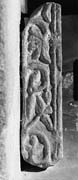
Object type: Shaft fragment [1]
Measurements: H. 34.8 cm (13.7 in) W. 23.8 > 20.5 cm (9.4 > 8.1 in) D. 9.1 > 8.6 cm (3.6 > 3.4 in)
Stone type: As Wensley 1 (Holy Trinity)
Plate numbers in printed volume: Ills. 861–4
Corpus volume reference: Vol 6 p. 221-222
(There may be more views or larger images available for this item. Click on the thumbnail image to view.)
A (broad) : The edge moulding is a double roll, the inner one very narrow (0.8 cm). Within the noticeably tapering panel is an open tangled plant-scroll which has buds and off-shoots but no developed leaf forms. The stems are narrow and well modelled, the cutting as deep as 1 cm. The main strands climb at the sides of the panel, the curling off-shoots interlacing in the middle ground. Some shootlets have a drop leaf, the node is ridged, and one tendril is scrolled.
B (narrow) : The double edge moulding is rolled. The right-hand side of the face is damaged. Within the panel is an open, deeply cut plant-scroll with median-incised stem and a tight bud in the spandrel.
C (broad) : Not visible, but 'destroyed' (Collingwood 1907).
D (narrow) : The double edge moulding is as on face A. The left-hand side of the face is damaged. The panel has a deeply cut plant-scroll with a narrow modelled stem. Offshoots bear tightly closed buds and paired leaves supporting triple fruit. The design is open.
The freedom and looseness of the plant-scrolls make for an organic rather than geometric design. The leafed fruit of face D has models in Late Antique plant-scrolls, but here the tangles of the plant's growth are more naturalistic than formal. The narrow sides work in regular registers but face A may well have been cut free-hand without griding. It is adventurous work.
