Select a site alphabetically from the choices shown in the box below. Alternatively, browse sculptural examples using the Forward/Back buttons.
Chapters for this volume, along with copies of original in-text images, are available here.


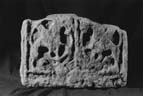
Object type: Shaft fragment
Measurements: H. 36 cm (14.2 in) W. 51 cm (20 in) D. 31.4 cm (12.4 in)
Stone type: Medium-grained feldspathic Millstone Grit with angular grains and containing a little mica. Very pale brown (10YR 7/4). Red Scar Grit, Namurian, Upper Carboniferous, which cap the hills to the west of this site.
Plate numbers in printed volume: Ills. 889–892
Corpus volume reference: Vol 6 p. 227-228
(There may be more views or larger images available for this item. Click on the thumbnail image to view.)
A (broad) : The outer roll of the double edge moulding is damaged. The more slender inner moulding is modelled and divides the face into frames, since it is continued axially upwards at the centre. Two adjacent panels, lost at the top, each contain a single profile animal in mirror image. Each is loosely interlaced by a well-modelled circular stem which may be a body extension from the animal. The roundel on the left-hand beast passes under the wing and over the loins. The creatures are winged quadrupeds, slightly rearing, with the wing stretched upwards diagonally. Both the torso and the legs taper elegantly. The heads face inwards and forwards and bite at the circling stem.
A narrow horizontal moulding separates them from carving below, which is now lost.
B (narrow) : Dressed.
C (broad) : Dressed, but there are remains of a narrow edge moulding adjacent to face B.
D (narrow) : The edge moulding is worn and broken. Portions of two panels remain, separated by a narrow transverse moulding, much worn. The upper panel contains a single profile animal, its head lost, facing left. The torso and legs taper in the manner of face A's beasts. The foreparts are now lost but Collingwood's drawing shows prancing forelegs and a loop around one leg. Below the transverse moulding is part of a volute crest. This face is very worn and much damaged.
The fragment appears to have had sculpture both above and below it: it is not the base of a shaft, and consequently it must have been a monument of considerable size. A width of 20 inches is unusual. The taste for individual animals within panels, and the interlacing circular strand, is also seen on the Cundall/ Aldborough shaft (Ills. 160–84) which is very probably by the same hand (Chap. VI, p. 41). The tapering torsos and limbs are as much a feature of Mercian creatures in the early ninth century as of prestigious monuments in Yorkshire. Masham 1 (Ills. 625–31) and shafts at Ilkley in the West Riding (Collingwood 1915, 186–92) provide parallels in Yorkshire sculpture, though the type's popularity stretched from the Gandersheim casket to the Thornhill shaft in Dumfriesshire (Webster and Backhouse 1991, cat. 138; Collingwood 1927a, fig. 68). The winged quadruped is something of a rarity amongst the usual bipeds, the only parallel being on Croft 1 (Ill. 152). The 'encircled beast' motif of this piece is an indication of the sculptor of Cundall/Aldborough, the Uredale master (Chap. VI, p. 42), and the transition from inhabited plant-scroll to scrolled body extensions is a feature of Yorkshire's ninth-century sculpture, both in the Ripon area and on the archbishop's estate in Wharfedale.
