Select a site alphabetically from the choices shown in the box below. Alternatively, browse sculptural examples using the Forward/Back buttons.
Chapters for this volume, along with copies of original in-text images, are available here.


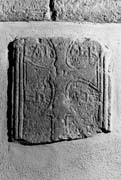
Object type: Part of grave-marker [1]
Measurements: H. 35.3 cm (13.9 in) W. 33.2 cm (13.1 in) D. Built in
Stone type: Medium-grained, feldspathic Millstone Grit, with some mica present. The true colour is masked by lime, but appears to be as Wensley 8 (Holy Trinity)
Plate numbers in printed volume: Ills. 884, 886
Corpus volume reference: Vol 6 p. 226-227
(There may be more views or larger images available for this item. Click on the thumbnail image to view.)
A (broad) : At each side is a triple edge moulding, the strands narrow and the outer one cut further back than the others. The inner ones are rolled. Within the panel is a type B9 cross carved in low relief with a perimeter moulding. The arm-pits are wide curves and the arms splayed, with the lower limb supported on an uninterrupted stem.
Inscription An inscription carved in relief has been arranged symmetrically in the four spaces around the cross. All the letters have been abraded and none is as well preserved as the O and the N on Wensley 8. The letters are also shorter than those on Wensley 8 (about 4 cm in height) and their stems are fatter (the stem of H is about 0.8 cm across). The inscription, which is in Insular decorative capitals, can be transcribed as follows:
The text consists of a form of a common Old English personal name: ĒATBEREH[C]T. This in normalized form would be Eadbeorht (Searle 1897, 176–8; Ström 1939, 165). The reading of the penultimate letter as C is corroborated by the same unusual spelling in the inscription on the Yarm cross-shaft (-berehct) . The unvoicing of the d of the first syllable can be paralleled in the legend Eotberehtus on a coin of the eighth-century Northumbrian king Eadberht (738–57) (Campbell 1959, §§ 275 and 450).[1] Haigh saw a T immediately to the right of the H and interpreted the [C]T as ET, which he took to be the Latin conjunction et, and in the space below he saw the letters ARUINI (Haigh 1881a, 46 and drawing on p. 45). There is now no trace either of the T following the H or of any lettering below the second line. Haigh's reading seems to have been suggested to him by the 'Arnuuini et Eadbertus interempti' entered under the year 740 in the Continuation of the Historia Ecclesiastica (Bede 1969, 574) and was based on the interpretation of a 'cast', presumably a paper squeeze, and not of the stone itself.
The Insular decorative capitals of the inscription are perceptibly different in treatment from those on Wensley 8. They are dumpier and it appears that their terminals were embellished with a combination of stem-thickening and wedge serifs (Okasha 1964–8, 331, table 2; Higgitt 1990a, 35–6), although the stone is too worn for certainty about this. The A is the decorative variant of the capital with a horizontal head-bar and a broken cross-bar, a form that can be found in Insular display script and inscriptions (A5 in Higgitt 1994, 219, 224). The B can be reconstructed as the sinuous-backed Insular half-uncial letter. The bowl, which is normally closed, is left open at the top as in the inscription on Whitby 47 (Ill. 1061). The three Es are of the standard capital form; the third E is a particularly broad letter. Enough remains of the third letter in the second line to show that it was the round capital C with a very narrow opening on the right side. The H is the Insular half-uncial letter. The T is a broad version of the standard capital.
B–D: Built in without being recorded.
Very closely related to no. 8, this is a less elaborate grave-marker. The outer edge moulding may be a form of rebate, in which case the stone may have formed part of a composite box-shrine. The analogues for the cross form are those cited for no. 8, the closest parallels being at York Minster.
Inscription Wensley 8 and 9 share the rare feature of an inscription cut in relief but there are some differences, particularly in layout and treatment. Both inscriptions consist of a single name but the inscription on this stone conforms to a more usual arrangement of text in the spaces around the cross (Okasha 1971, pls. 45, 48–50, 75–6, 80, 91; id. 1992, pl. IVa; Page, R. 1999, figs. 11, 12). The differences in treatment between the compressed and narrow lettering of Wensley 8 and the broad and more spaciously laid-out lettering on this stone are appropriate to the different fields that they occupy. They seem, however, to be a matter of stylistic preference and suggest that different designers were responsible for the forms of the lettering on the two stones. The lettering of both inscriptions includes distinctively Insular half-uncial forms. As on Wensley 8, the carving of Insular decorative capitals in relief can probably be dated to some time in the second half of the eighth or early ninth century.
