Select a site alphabetically from the choices shown in the box below. Alternatively, browse sculptural examples using the Forward/Back buttons.
Chapters for this volume, along with copies of original in-text images, are available here.


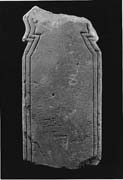
Object type: Part of cross-shaft and -head [1]
Measurements: H. 67 cm (26.4 in) W. 32 > 31 cm (12.6 > 12.2 in) D. 14.5 > 14 cm (5.8 > 5.5 in)
Stone type: Medium- to coarse-grained ferruginous sandstone, micaceous and feldspathic, well sorted sediments with sub-rounded grains; prominent bedding planes parallel to main cross faces. Largely white coloured (10YR 8/2) with surface layer of light brown (10YR 6/4). Stone provenance as Whitby 1 (abbey, St Peter and St Hilda)
Plate numbers in printed volume: Ills. 907–10
Corpus volume reference: Vol 6 p. 235
(There may be more views or larger images available for this item. Click on the thumbnail image to view.)
A (broad) : The shaft and remaining stump of the lower limb have a continuous modelled edge moulding. The neck of the shaft is nipped to support the horizontal base of the lower limb, delineated by the edge mouldings. At the left enough of the arm survives to show that it was cusped; type D9 or 10. The cutting is very finely dressed.
B (narrow) : Plain. The chamfer of the neck and the lip of the cusped arm are prominent. Finely dressed.
C (broad): As face A, but damaged.
D (narrow) : As face B.
The technique of cutting and smoothing the surface is identical with nos. 1 and 2. The cross shape differs, however, in having the cusped form, and the lower arm is sculpted.
