Select a site alphabetically from the choices shown in the box below. Alternatively, browse sculptural examples using the Forward/Back buttons.
Chapters for this volume, along with copies of original in-text images, are available here.


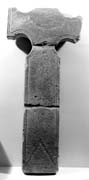
Object type: Part of cross-shaft and -head, in three joining pieces [1]
Measurements: H. 135 cm (53.15 in) W. (shaft) 29.3 > 28.5 cm (11.5 > 11.2 in); (cross-arms) 60.8 cm (23.9 in) D. 15.5 cm (6.1 in)
Stone type: As Whitby 1 (abbey, St Peter and St Hilda)
Plate numbers in printed volume: Ills. 900–2
Corpus volume reference: Vol 6 p. 235
(There may be more views or larger images available for this item. Click on the thumbnail image to view.)
A (broad) : A type A10 cross, it has widely curving arm-pits and shallow squared tips (slightly cusped below). The shaft is gently tapered, and edged with a double roll moulding, each strand narrow, which continues round the perimeter of the cross. At the base of the shaft the inner moulding forms a chevron across the face. The dressing is smooth.
B and D (narrow) : Plain.
C (broad) : Plain. Not currently visible.
Whilst the neck of the shaft sweeps uninterruptedly into the cross-head, the shallow squared tips in relation to the arms' curves still gives the impression of an equal-armed cross surmounting the shaft, rather than a Latin cross (contra Kelly 1993, 221; Bailey 1996a, 51). Comparison with no. 1's mouldings reveals a very similar profile, and the view that this cross stems from an Irish tradition in which the shaft and the lower vertical limb are one is not altogether soundly based. This form could have been independently derived from a wooden prototype. The chevron at the base is reminiscent of the incised saltires on some of the York stelae (Lang 1991, 60) which also share the smooth dressing and restrained decoration (see Chapter VI). Since face C is uncarved it is probable that the cross stood indoors with its back to a wall.
