Select a site alphabetically from the choices shown in the box below. Alternatively, browse sculptural examples using the Forward/Back buttons.
Chapters for this volume, along with copies of original in-text images, are available here.


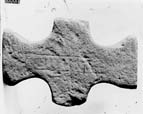
Object type: Incomplete cross-head [1]
Measurements: H. 29.5 cm (11.6 in) W. 44.5 cm (17.5 in) D. 13.2 > 12.3 cm (5.2 > 4.8 in)
Stone type: Medium-grained micaceous sandstone containing feldspar. The rock fabric is well sorted with sub-angular/sub-rounded grains. Although the original body colour is light yellowish brown (10YR 6/4), it has been extensively burnt to a light reddish brown colour (5YR 6/4). The cross exhibits crude cross-bedding parallel to the lettered face. Stone provenance probably as Whitby 20 (abbey, St Peter and St Hilda); not from the Aislaby Quarries
Plate numbers in printed volume: Ills. 993–9
Corpus volume reference: Vol 6 p. 248-249
(There may be more views or larger images available for this item. Click on the thumbnail image to view.)
A (broad) : A type A10 cross-head, the arms have straight tips and widely curving arm-pits. Two parallel incised lines run across the face of the cross; they are not axial and are very faintly incised, but there seems to be a vertical line on the left implying that this was originally a rectangle.
Alleged inscription The two parallel lines running across face A seem to have been incised to contain a short inscription. At one end of the panel faint traces of a vertical seem to close the panel but the stone is too worn at the other end to confirm this feature. Between the parallel lines are what look like traces of a number of incised verticals but there are no clear remains of lettering. Collingwood (1911, 302) and Brown (1937, 100–1, fig. 12) thought that the inscription was runic but either largely or totally illegible, whilst Okasha (1971, 121) was uncertain what script had been used. Radford dismissed the marks as accidental damage and Page seemed to agree with him (Peers and Radford 1943, 37; Page, R. 1995, 171).
B (narrow) and C (broad) : Plain.
D (narrow) : Plain, but with a mortise hole off-centre (probably modern).
E (upper) and F (lower) : The armpits are smoothly dressed.
These must be lateral limbs (contra Radford) since the arm tips are intact and neither can have joined a shaft. In that case the parallel lines are horizontal and may have once borne an incised or painted inscription. Since these plain crosses are possible developments from a wooden form, the framing of the inscription could be a reminiscence of a metal plate.
Alleged inscription If this was an inscription, it would have resembled Whitby 20, 21 and 23 in being set in the centre of a cross-head. The parallel lines run about 5 cm apart, which would have allowed for letters of the height of, for example, those on Whitby 20 or 21. The lettering would have had to have been very lightly incised to have been abraded away so thoroughly. The fact that the parallel lines are not exactly at right angles to the sides of the cross-head would suggest a degree of informality or carelessness. Setting inscriptions on stone between deeply incised lines seems to have been characteristic of the ninth century and later in England, and normally such inscriptions are, like Whitby 47 (Ill. 1061), in more than one line. The possible inscription on this stone would have occupied the centre of the available field and would have differed in this respect from five ninth- to eleventh-century examples of single-line inscriptions set between incised framing lines on English monuments (at Aldbrough, Stratfield Mortimer, Stow and Winchester). These inscriptions all run along the edge of one face or of a carved feature, such as a dial (Lang 1991, ill. 418; Tweddle et al. 1995, ills. 490, 667–8, 695–709; Everson and Stocker 1999, ill. 358). The inscription on Whitby 26, if it existed, could of course have been cut at a later date, possibly marking a reuse of the cross.
