Select a site alphabetically from the choices shown in the box below. Alternatively, browse sculptural examples using the Forward/Back buttons.
Chapters for this volume, along with copies of original in-text images, are available here.


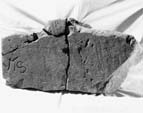
Object type: Part of cross-head, in three joining pieces [1]
Measurements: L. 51 cm (20 in) W. 26 > 21 cm (10.2 > 8.3 in) D. 9 cm (3.5 in)
Stone type: Fine-grained micaceous deltaic sandstone, well bedded (cross-bedded parallel to the lettered face of the cross-head). Light yellowish brown (10YR 6/4). Stone provenance as Whitby 20 (abbey, St Peter and St Hilda)
Plate numbers in printed volume: Ills. 988–92
Corpus volume reference: Vol 6 p. 247-248
(There may be more views or larger images available for this item. Click on the thumbnail image to view.)
A (broad) : Plain and smoothly dressed. Two incised letters are randomly placed close to the tip of one arm.
D.C.
Inscription The two letters on this fragment were incised near the edge of one of the two broad faces. The axis of the one closest to the edge is more or less parallel with it but the other letter was cut at an arbitrary angle to its neighbour. The letters were well executed but were clearly not part of the original design of the monument. It is probable that they were cut as trial or practice letters. The letters are about 4 cm in height. The letter closest to the edge of the stone was probably intended as half-uncial H, although its vertical extends only a short way above the top of the right-hand stroke. Other possible, but less likely, readings are half-uncial N or, if viewed the other way up, uncial or half-uncial U. The other letter is capital S (a form also used in Insular uncial and half-uncial scripts).
J.H.
B (narrow) : Broken.
C (broad) : Roughly dressed; part of the face has split off.
D (narrow) : Smoothly dressed and plain, with long vertical dressing marks.
E (upper) : Remains of two curved armpits.
F (lower) : Remains of only one armpit below the lettering.
That this is part of a large plain cross-head rather than a slab (contra Okasha 1971, no. 131) is confirmed by the three surviving armpits, which are carefully dressed. There is no evidence for a fourth armpit on the lower right edge, so the cross may have been left unfinished. The damaged arm on the left is possibly of type B10; there is no evidence for edge mouldings. This cross-head is unusually shallow in depth, and the rough dressing on the reverse suggests that the cross may have been intended to stand against a wall.
Inscription Peers and Radford (1943, 37) seem to have thought that the lettering on Whitby 25 was of the same period as that on Whitby 24, that is 'probably medieval', that is post-Conquest, although in neither case are the reasons for their attribution clear.[2] On balance, and in the context of the other inscriptions found on this site, it is more probable that these two letters were cut at about the same time as the rest of the inscriptions. Neither form, however, is clearly diagnostic, and even the identity of one of the two letters is uncertain. Although not very pronounced, the serifing would be compatible with an eighth- or ninth-century dating. Whatever their purpose or significance, the letters were very unlikely to have formed part of the original design of the cross-head.
[1] The following are general references to the Whitby stones: Hood 1927, 38, 45, 49; Kendall 1932, 9–10, 26–7, 28; Peers and Radford 1943, 33–40; Clapham 1952, 11; Wilson, D. 1964, 9; Cramp 1965b, 4; Fellows-Jensen 1972, 218; Cramp 1976a, 228; Cramp 1976b, 455–7; Rahtz 1976, 460; Cramp 1978a, 7; Bailey 1980, 81, 82; Okasha 1983, 118; Cramp 1984, 9, 79, 109, 180, 222; Higgitt 1986b, 130–1, 134, 148; Bailey and Cramp 1988, 55, 56, 85, 154; Cramp 1989, 223; Lang 1989a, 67; Lang 1990a, 2–3; Higgitt 1991, 45; Lang 1991, 24, 109, 138, 139; Cramp 1992, 8, 24, 107, 224, 252; Okasha 1992, 84; Cramp 1993, 68–9, 71; Fellows-Jensen 1995, 177; Higgitt 1995, 229–36; Rahtz 1995, 7–8; Bailey 1996a, 50–1, 111; Hawkes 1999b, 403, 410–16; Karkov 1999, 133–4; Stocker 2000, 200; Stopford 2000, 102, 104.
[2] In fact Peers and Radford compare Whitby 25 to Whitby 22, although, from the context, this is clearly an error for Whitby 24.
