Select a site alphabetically from the choices shown in the box below. Alternatively, browse sculptural examples using the Forward/Back buttons.
Chapters for this volume, along with copies of original in-text images, are available here.


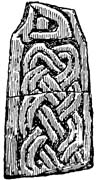
Object type: Upper part of cross-shaft [1]
Measurements: (after Collingwood 1911) H. 48.3 cm (19 in) W. 24.2 cm (9.5 in) D. 12.7 cm (5 in)
Stone type: Grey sandstone' (ibid.)
Plate numbers in printed volume: Ill. 1030
Corpus volume reference: Vol 6 p. 252-253
(There may be more views or larger images available for this item. Click on the thumbnail image to view.)
The description relies entirely upon Collingwood's two reports (1907, 408; 1911, 302, fig. a). [2]
A (broad) : The top of a shaft and neck of a cross-head have a plain edge moulding. The neck's panel has a large D-shaped loop with a pellet filler within it. The shaft's panel contains the upper part of a four-cord plain plait in median-incised strand, boldly cut in 'hacked work'.
B (narrow) : 'Single strap twist' within a plain edge moulding.
C (broad) and D (narrow) : Not recorded. Collingwood noted: 'At the time of my visit the key was not to be found, and I could draw only the side visible through the glass' (1911, 302).
Collingwood was right to comment that this Anglo-Scandinavian cross demonstrates that burials continued on the headland after the Viking settlement. 'Mr George Buchannan, of Whitby, says that this stone was found in working the quarry near the edge of the cliff, together with interments, some of which were not disposed east and west' (Collingwood 1911, 302). He compared the interlace with patterns at Kirklevington (id. 1907, 408).
[1] The following are general references to the Whitby stones: Hood 1927, 38, 45, 49; Kendall 1932, 9–10, 26–7, 28; Peers and Radford 1943, 33–40; Clapham 1952, 11; Wilson, D. 1964, 9; Cramp 1965b, 4; Fellows-Jensen 1972, 218; Cramp 1976a, 228; Cramp 1976b, 455–7; Rahtz 1976, 460; Cramp 1978a, 7; Bailey 1980, 81, 82; Okasha 1983, 118; Cramp 1984, 9, 79, 109, 180, 222; Higgitt 1986b, 130–1, 134, 148; Bailey and Cramp 1988, 55, 56, 85, 154; Cramp 1989, 223; Lang 1989a, 67; Lang 1990a, 2–3; Higgitt 1991, 45; Lang 1991, 24, 109, 138, 139; Cramp 1992, 8, 24, 107, 224, 252; Okasha 1992, 84; Cramp 1993, 68–9, 71; Fellows-Jensen 1995, 177; Higgitt 1995, 229–36; Rahtz 1995, 7–8; Bailey 1996a, 50–1, 111; Hawkes 1999b, 403, 410–16; Karkov 1999, 133–4; Stocker 2000, 200; Stopford 2000, 102, 104.
[2] Romilly Allen's sketch, which was shown to Collingwood, does not appear to survive amongst his papers deposited in the British Library (BL Add. MSS 37539–37628). (Eds.)
