Select a site alphabetically from the choices shown in the box below. Alternatively, browse sculptural examples using the Forward/Back buttons.
Chapters for this volume, along with copies of original in-text images, are available here.


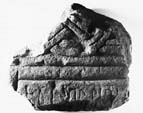
Object type: Cross-shaft fragment [1]
Measurements: H. 23 cm (9.1 in) W. 24.3 cm (9.6 in) D. 10.3 cm (4 in)
Stone type: Very fine-grained micaceous deltaic sandstone which contains some feldspar; a poorly sorted sandstone. Main body colour varies from very pale brown (10YR 8/3) to light grey (10YR 7/2). However, the back of the fragment shows signs of being burnt, with the resulting colour change to a pink hue (5YR 7/3). Stone provenance as Whitby 1 (abbey, St Peter and St Hilda)
Plate numbers in printed volume: Ills. 1021–2
Corpus volume reference: Vol 6 p. 251-252
(There may be more views or larger images available for this item. Click on the thumbnail image to view.)
A (broad) : At the left a plain roll moulding survives and turns across the neck of the shaft. The moulding is marked by an inner incised line which cuts the transverse moulding. Above it is another well modelled transverse moulding which supports the terminal loops of interlace in broad median-incised strand, boldly cut and well modelled. In the panel below, of which little remains, is part of the first line of an inscription, heralded by an incised cross with serifs.
Inscription The upper parts of characters at the beginning of a line of incised lettering preceded by an introductory cross are all that now remains of an inscription set into a framed panel at what seems to be the top of a cross-shaft. The height of the letters, when complete, can be estimated at about 3 cm. The script seems to have consisted of mixed capitals and perhaps to have included some runic forms.
The language and meaning of this fragmentary text are uncertain. Even the classification of the script is problematic. Peers and Radford published it as runic, although war-time conditions prevented Radford from examining the original (Peers and Radford 1943, 39, 40). Page accepted that some characters 'look like runes', whereas others 'are clearly non-runic' (Page, R. 1995, 171–2). The transcription above is in line with Page's implied suggestion that the inscription was in a mixture of Roman and runic characters.
B, C and D: Broken away.
The deep cutting and bold interlace contrast with the earlier Whitby Plain Cross series, but the same type of interlace with an inscribed panel below is also found at Hackness, a daughter house of Whitby (Lang 1991, 135–41, no. 1, ills. 462–3).
Inscription Whitby 34 appears to be a fragment of the junction between the top of one of the broad faces of the shaft and the head of a cross. If so, it can be associated with a small group of Anglo-Saxon crosses that display inscriptions in a panel at the top of one of the broad face of the shaft. The other examples are at Hexham, Hornby, Lancaster, Ripon and Wycliffe (Higgitt 1986b, 130). Two of the inscribed panels on the Hackness cross were similarly positioned at the top of the shaft, although in this case on the faces that were slightly narrower than the two principal faces (Lang 1991, 135–41, ills. 455, 456, 458–61). Whitby 34 seems therefore to represent a different tradition from that of the plain crosses with inscribed heads that have been found at Whitby (Whitby 20, 21, 22, 23 and perhaps also 24 and 26). It could represent a later phase than the inscribed cross-heads, or perhaps a monument of a different status or purpose.
The only indisputable character of the inscription is the introductory cross, a feature found in many Anglo-Saxon inscriptions. The first letter was very probably capital A with a bar across the top. It is, however, possible to read it as a rune, that is as 'a seriffed 'u"(Page, R. 1995, 172). This is followed by a space large enough for two characters but the area is damaged and nothing can now be made out. The next fragmentary character that Page (1995, 172) plausibly suggests as a possible rune (either 'w' or 'þ') seems to be one that is set slightly higher than the rest and very close to the following character. Its stem leans backwards away from the vertical, and the upper part of what may have been a bow seems almost to touch the next character. It looks as if it may have been an afterthought. The following character was not a rune but it could be reconstructed as a rectangular capital O (or possibly Q). Rectangular O was a form employed amongst Insular decorative capitals, both in manuscript display script and in inscriptions, for example, in Northumbria, at Hartlepool and York (Okasha 1971, pls. 46, 47 and 151; Higgitt 1994, 229). Rectangular forms of Q appear in the display scripts of the Lichfield Gospels, St Gall, and Macregol Gospels (Duft and Meyer 1953, Taf. VIII; Alexander 1978, ills. 78 and 268). Next comes Page's possible runic 'l' (1995, 172). This is followed by what was probably a capital P with a bowl open at the base. The following vertical probably belonged either to an I or a narrow capital L. To its right was a rounded, almost certainly Roman character.
None of the suggested runic identifications is definite but it is at least possible that this inscription was in capitals mixed with a number of runes in addition to the frequently borrowed thorn and wynn. There are Northumbrian examples from Chester-le-Street and Alnmouth that have been dated to the late ninth and the late ninth to early tenth century respectively (Cramp 1984, 53–4, 161–2, pls. 20, 102 and 157, 810; Page, R. 1995, 174). The presence of runes amongst the capitals would therefore suggest a comparatively late date in the history of the early monastery at Whitby, probably in the ninth century.
