Volume 6: Northern Yorkshire
Select a site alphabetically from the choices shown in the box below. Alternatively, browse sculptural examples using the Forward/Back buttons.
Chapters for this volume, along with copies of original in-text images, are available here.
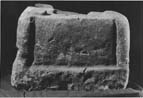
Current Display: Whitby 55 (abbey), Yorkshire North Riding


Overview
Object type: Cross-base [1]
Measurements:
L. 66 > 62 cm (26 > 24.4 in) W. 56 > 51 cm (22 > 20 in) H. 45 > 38 cm (17.7 > 15 in)
Socket: L. 34 cm (13.3 in) W. 21 cm (8.3 in) D. 17.5 cm (7 in)
Stone type: Medium-grained feldspathic, micaceous sandstone. Massively bedded with liesegang marks, bedding strongly oblique to the top surface. Brown (10YR 5/3). From the Saltwick Formation, Aalenian, Middle Jurassic, probably from cliff-top quarries in the vicinity of the monastic site
Plate numbers in printed volume: Ills. 1088–95
Corpus volume reference: Vol 6 p. 265
(There may be more views or larger images available for this item. Click on the thumbnail image to view.)
Present Location
English Heritage North Region store, Helmsley (EH 88092677)
Evidence for Discovery
See Whitby 1 (abbey, St Peter and St Hilda). Found in situ to the north of the north transept on 21 August 1924 (Whitby finds register, no. 768), together with no. 56, and recorded in photographs of the excavation (English Heritage archive: see Ill. 1095 and below), and on the published site plan (Peers and Radford 1943, pl. XXXI).
Church Dedication
St Peter and St Hilda
Present Condition
Worn and weathered; the upper surface partly damaged, and a diagonal crack in one panel. Another English Heritage photograph (AA010018) shows that the crack was visible in November 1924, but the boss on the upper surface at the end of this crack has since broken away.
Description
Each face has a plain panel, enclosed at each corner by a bold columnar feature set on a broad band at the base and terminating at the top in a worn boss-shaped feature, one of which (less worn than the others) seems to have been composed of a collar and low capital. The collar is extended as a roll moulding across the top of the adjacent panels.
Discussion
This cross-base was found in situ in the early site excavations with the less decorated base, no. 56, beside it (Ill. 1095). The architectural form of this piece is unusual in cross-bases, many of which are uncarved, but comparison can be made with the decorated base from Lindisfarne (Cramp 1984, 201, pls. 196–7).
R.C.
Date
Eighth to ninth century(?)
References
Peers and Radford 1943, 32, pl. XVIIIc; Rahtz 1976, 460; Cramp 1993, 68
Endnotes
[1] The following are general references to the Whitby stones: Hood 1927, 38, 45, 49; Kendall 1932, 9–10, 26–7, 28; Peers and Radford 1943, 33–40; Clapham 1952, 11; Wilson, D. 1964, 9; Cramp 1965b, 4; Fellows-Jensen 1972, 218; Cramp 1976a, 228; Cramp 1976b, 455–7; Rahtz 1976, 460; Cramp 1978a, 7; Bailey 1980, 81, 82; Okasha 1983, 118; Cramp 1984, 9, 79, 109, 180, 222; Higgitt 1986b, 130–1, 134, 148; Bailey and Cramp 1988, 55, 56, 85, 154; Cramp 1989, 223; Lang 1989a, 67; Lang 1990a, 2–3; Higgitt 1991, 45; Lang 1991, 24, 109, 138, 139; Cramp 1992, 8, 24, 107, 224, 252; Okasha 1992, 84; Cramp 1993, 68–9, 71; Fellows-Jensen 1995, 177; Higgitt 1995, 229–36; Rahtz 1995, 7–8; Bailey 1996a, 50–1, 111; Hawkes 1999b, 403, 410–16; Karkov 1999, 133–4; Stocker 2000, 200; Stopford 2000, 102, 104.