Volume 6: Northern Yorkshire
Select a site alphabetically from the choices shown in the box below. Alternatively, browse sculptural examples using the Forward/Back buttons.
Chapters for this volume, along with copies of original in-text images, are available here.
Current Display: Whitby 54 (abbey), Yorkshire North Riding


Overview
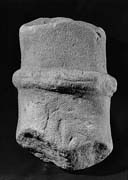
Object type: Fragment of baluster shaft [1]
Measurements: H. 27 cm (10.6 in) W. 19 > 15 cm (7.5 > 5.9 in) D. 13 cm (5.1 in)
Stone type: Cut in coarse-grained, ferruginous, feldspathic, well sorted sandstone. Only weathered surfaces were available for examination so the light yellowish-brown to brownish-yellow colour (10YR 6/4–6/6) may not be a true representation. Stone provenance probably as Whitby 1 (abbey, St Peter and St Hilda)
Plate numbers in printed volume: Ills. 1086–7
Corpus volume reference: Vol 6 p. 265
(There may be more views or larger images available for this item. Click on the thumbnail image to view.)
Present Location
English Heritage North Region store, Helmsley (EH 81430702)
Evidence for Discovery
See Whitby 1 (abbey, St Peter and St Hilda). Probably the 'part of moulded shaft', found 3 April 1924, on the north side of the chancel opposite the north-west angle (Whitby finds register, no. 499), together with other architectural fragments (see Table 4).
Church Dedication
St Peter and St Hilda
Present Condition
Broken in half down the section; fairly crisp
Description
One half of a tapering baluster shaft, originally slightly ovate in section. A broad humped encircling band in the middle is median-incised. Above and below the band the surface of the baluster splays outward.
Discussion
This baluster is unlike no. 53 in that it is hand-cut rather than lathe-turned. It is difficult to reconstruct its original shape, but it is probably for another purpose and could be later.
R.C.
Date
Eighth century
References
Peers and Radford 1943, 33
Endnotes
[1] The following are general references to the Whitby stones: Hood 1927, 38, 45, 49; Kendall 1932, 9–10, 26–7, 28; Peers and Radford 1943, 33–40; Clapham 1952, 11; Wilson, D. 1964, 9; Cramp 1965b, 4; Fellows-Jensen 1972, 218; Cramp 1976a, 228; Cramp 1976b, 455–7; Rahtz 1976, 460; Cramp 1978a, 7; Bailey 1980, 81, 82; Okasha 1983, 118; Cramp 1984, 9, 79, 109, 180, 222; Higgitt 1986b, 130–1, 134, 148; Bailey and Cramp 1988, 55, 56, 85, 154; Cramp 1989, 223; Lang 1989a, 67; Lang 1990a, 2–3; Higgitt 1991, 45; Lang 1991, 24, 109, 138, 139; Cramp 1992, 8, 24, 107, 224, 252; Okasha 1992, 84; Cramp 1993, 68–9, 71; Fellows-Jensen 1995, 177; Higgitt 1995, 229–36; Rahtz 1995, 7–8; Bailey 1996a, 50–1, 111; Hawkes 1999b, 403, 410–16; Karkov 1999, 133–4; Stocker 2000, 200; Stopford 2000, 102, 104.