Select a site alphabetically from the choices shown in the box below. Alternatively, browse sculptural examples using the Forward/Back buttons.
Chapters for this volume, along with copies of original in-text images, are available here.


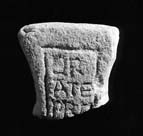
Object type: Cross-arm fragment
Measurements: H. 8.3 cm (3.2 in) W. 8.5 cm (3.3 in) D. 6.4 > 6.1 cm (2.5 > 2.4 in)
Stone type: [Sandstone]
Plate numbers in printed volume: Ills. 1201–4
Corpus volume reference: Vol 6 p. 302-303
(There may be more views or larger images available for this item. Click on the thumbnail image to view.)
The head is basically type E10 although the curve at the end is very slight.
A (broad) : An incised inscription is set within a rectangular panel formed by single incised lines.
Inscription [2] One of the two broad faces is occupied by the opening of an incised inscription set within a rectangular panel that is framed by incised lines. The panel is 4 cm across at the top and tapers down to 3.6 cm. There is a slight wobble in the cutting of the left-hand vertical of the frame. The surface is worn, with the result that the finer details of the lettering are now hard to judge. The inscription now consists of two complete horizontal lines of Roman lettering and the upper part of a third, the lower part of which is cut away at the break. The letters are a little uneven in size and layout and were cut without the help of ruled guidelines. The R is line 1 is 1.5 cm in height, whereas the T and E in line 2 are 1 cm. The inscription is in capitals and may be read as follows:
This is clearly the opening of a Latin text: ORATE PRO — ('Pray for —'). The capitals correspond to or are variations of their 'Roman' forms. The diagonals of A do not quite meet at the top but are topped by a head-bar. The cross-bar of the A is worn but seems to have been straight. Both bars incline downwards slightly to the left, although they were probably intended to be horizontal. The E is a broad version of the Roman capital, although the angles are a little indistinct and the 'horizontals' again dip down to the left. The opening O is damaged but it was clearly meant to be a rectangular version of the capital. The incomplete final letter of line 3 was again almost certainly rectangular O, even if the right angles are very approximate. The bows of the P and the two Rs remain open at the bottom and in each case the vertical continues a short way above the junction with the top of the bow. There are hints of serifs at the tops of the verticals of P and R in line 3 but wear has left the details indistinct. T is the simple capital.
B (narrow) : Smoothly dressed and plain, save for a curving incised line which seems accidental.
C (broad) : A section of four-strand plait in which the strands merge into the edges of the arm. The junction of the strands at the top are not clear, but at the narrow end (which would have been the centre of the head) the strands appear to terminate alongside a curving moulding which could have enclosed a central feature.
D (narrow) : Smoothly dressed and plain.
E (top) : Smoothly dressed and worn, with a hole about 1.5 cm in diameter, slightly off-centre. This is squarish at the surface and cylindrical below, and might be secondary.
This type of cross-head with no outlining or edge mouldings seems a typical form for the Whitby heads with inscriptions (see nos. 20–26, Ills. 964–99). It is, however, more elaborately carved than the rest: the inscription is framed (see below) and the opposite face is decorated. The simple interlace is quite neatly cut, but the strands are rather wide for the available space and the pattern is uncertain. Interlace is not a common motif at Whitby, but when it occurs elsewhere, as on nos. 34–36, it is double stranded or median incised (Ills. 1021–5, 1030). This may therefore be a 'one off' attempt at the motif. The hole at the end of the arm presents a problem, since if this is a dowel it should be the lower vertical which would be doweled onto the shaft, but the surface is curving and uninterruptedly worn as would be normal in an upper arm. Holes in the arms of crosses are not unknown elsewhere, and it has been suggested, for example in relation to Rothbury 1, Northumberland, that these could have been used to support lights, foliage, or some other form of 'dress' on certain occasions (Cramp 1984, 221). If this were so for this Whitby piece then it may have had a special commemorative value.
Inscription This newly found fragment is a further example of the variety in the types of inscribed stone monuments that were used in early Anglo-Saxon Whitby. Five, or perhaps six, other fragments of inscribed cross-heads from Whitby were already known (Whitby 20–24, and perhaps 26), each distinct in type: this resembles none of them. In the first place, the cross must have been smaller in scale than the other inscribed crosses from Whitby. The lettering is also smaller, at between 1 and 1.5 cm in height. In scale, it is closer to the centre of a cross-head found at St Mary Bishophill Junior in York, the central roundel of which is 8.5 cm across and contains letters of about 1 cm in height (Okasha 1971, 132, pl. 148; Lang 1991, 85–7, ill. 234). The incised frame around the inscription is unmatched on the Whitby cross-heads, except possibly (and not exactly) on the doubtful inscription on Whitby 26 (Ill. 993). The two early Anglo-Saxon inscribed cross-heads from Carlisle are closer, although there the framing lines follow the outline of the cross-head (Okasha 1971, pls. 23a, 23b and 24). A similar incised frame can also be seen on Whitby 37, which seems to have been a stele rather than a cross-head (Ill. 1036).
The inscription was in Latin, as were those on Whitby 20, 47 and 48. The formula used was either orate pro anima X ('pray for the soul of X') or orate pro X ('pray for X'). Orate pro anima X occurs, or occurred, on two inscribed crosses at Lancaster and perhaps also on a lost inscribed fragment from Norham that may have come from a cross, as well as on two grave-markers in York (Okasha 1971, 89–90, 103–4, 133, 134–5, pls. 67, 68, 96, 150, 152; Cramp 1984, 212; Higgitt 1986, 133; Lang 1991, 64, 75–6). The orate [or ora] pro X formula can be read on two of the Hartlepool name-stones and on a fragmentary slab from Billingham (Okasha 1971, 52–3, 77–8, pls. 9, 46–7; Cramp 1984, 51–2, 99–100). The inscription and therefore also the cross were very probably funerary in purpose.
The inscription opened without an introductory cross and, in that respect, can be compared to Whitby 20 (Ill. 964), if the first word on that fragment was the original opening of its text. Introductory crosses were, however, used on Whitby 21 and 34 (Ill. 970, 1021). The small scale of the lettering has already been compared to that on the cross-head from St Mary Bishophill Junior in York, but the Whitby inscription cannot match the control and elegance of that at York. The layout is free-hand and slightly awkward, for example in the space left at the end of the first line. The lettering on this fragment does not closely resemble that in any of the other Whitby inscriptions, as far as they can be judged in their very fragmentary state. The most interesting of the capitals is the rectangular O, a form that can be found amongst Insular decorative capitals, both in manuscript display script and in inscriptions from York and Hartlepool (Higgitt 1994, 229; Okasha 1971, pls. 46, 47 and 151). It also occurred amongst plainer capitals in the Roman letter inscriptions on the fragments of a stone cross at Hackness (Lang 1991, 136–9, ills. 458, 461, 466). Rectangular O is also the most probable reading of the damaged rectangular character on Whitby 34 (Ill. 1021). The parallels for this letter form and the general character of the capitals on this fragment suggest a dating in the eighth or early ninth century.
[1] Information by courtesy of Sarah Jennings, English Heritage.
[2] I would like to thank Martin Allfrey and Sarah Jennings of English Heritage for supplying me with information and illustrations of this fragment and for making it possible for me to examine it.
