Select a site alphabetically from the choices shown in the box below. Alternatively, browse sculptural examples using the Forward/Back buttons.
Chapters for this volume, along with copies of original in-text images, are available here.


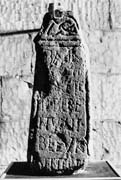
Object type: Upper part of cross-shaft and lower arm [1]
Measurements: H. 50.5 cm (19.9 in) W. 19.5 > 10 cm (7.7 > 3.9 in) D. 16.5 > 14.5 cm (6.5 > 5.7 in)
Stone type: Fine-grained dolomitic limestone. Very pale brown (10YR 8/3). Magnesian Limestone (Cadeby Formation, Upper Permian), probably from the Tadcaster area of Yorkshire; not typical of the stone quarried extensively in the Hartlepool area of co. Durham. Possibly reused stone from a nearby Roman site such as the fort at Greta Bridge.
Plate numbers in printed volume: Ills. 1099–1103
Corpus volume reference: Vol 6 p. 266-269
(There may be more views or larger images available for this item. Click on the thumbnail image to view.)
The piece consists of the upper section of the shaft and the lower arm of the cross-head.
A (broad) : The surviving face of the shaft is surrounded by vestiges of a single roll moulding which encloses a memorial inscription in Anglo-Saxon capitals. The outline of the lower limb of the cross is marked by a roll moulding which encloses a loose fine-stranded knot in a variant of pattern E. The original depth of the fine strands has been much eroded, but this was clearly a relief motif and not incised.
Inscription The inscription occupies all that survives of one of the two broader faces of the cross-shaft. It was set in a panel surrounded by a framing fillet. Seven lines of incised lettering remain before the break, which cuts into the lower parts of the letters in the bottom line. The surface is worn and there are several areas of damage. Although most of the damage had occurred by 1780, the date of the first illustration of the stone, the lettering seems to have suffered further losses since that time (Cowen and Barty 1966, 67 and pls. V, fig. 1, VII and VIII). The lines of lettering vary in height, individual letters ranging between 4.5 cm (the opening B in line 1) and 2 cm (the T in line 2). The inscription is in capitals and may be transcribed as follows:
The language is clearly Old English. The evidence of the lettering on the stone can be supplemented in some places with that of an etching made in 1780 and a nineteenth-century squeeze worked up with pencil, both now in collections of the Society of Antiquaries of London (Cowen and Barty 1966, pls. V, fig. 1, and VIII). There would have been insufficient room on the stone for the introductory cross suggested by Okasha (1971, 130). The following reading can be offered:
BA[DA] [—T—] [A]EFTE[R] [:] BEREHTVINI : BE[C]VN [A]EFTER [. .] —
Surviving traces supplemented by the evidence of the etching and the squeeze show that the third letter in the line 1 was a rectangular letter, probably an angular version of Insular half-uncial D. The probable T in line 2 may, in this context, have formed part of a verb, perhaps a form of sette or asette ('erected' etc.). The inscription is clearly incomplete at the end and at least one further line has been lost.
A literal translation following the order of the Old English might give: 'Ba[da] [erected?] in memory of Berehtuini, a monument in memory of —'. The word following the name 'Berehtuini' was probably a noun in apposition to it (see below), so that the sense was probably: 'Ba[d]a [erected?] a monument in memory of Berehtuini, [his?] —'.
The layout is reasonably neat and the lines of lettering may have followed ruled horizontal guidelines but, if so, they did not do so slavishly, as can be seen from the bottoms of letters in line 6. Guidelines may have been in chalk or charcoal, since there is now no trace of incised guidelines on the stone.
Damage to the surface has obscured details of many letters and makes an analysis of letter-forms problematic. The etching of 1780 and the nineteenth-century squeeze may preserve details that are now obscure on the stone (Cowen and Barty 1966, pls. V, fig. 1, and VIII). The capitals mostly appear tall and slender in their proportions. E, F, I, T and V seem to have conformed to the standard 'Roman' types. The first A in line 1 had a short top bar, perhaps projecting only to the left. The ends of the angled cross-bar seem to have been projected to form a type of 'x'. This is an unusual form but can be found amongst the decorative capitals on the eighth-century Ardagh Chalice (Dunraven 1874, pl. V). The inner ends of the bows of the Bs in lines 1 and 4 may have extended as far as the vertical stem, whereas those in the B in line 6 may always have stopped short of the vertical. The damaged C in line 6 must have been the rectangular form. The probable D in line 1 seems to have been a rectangular variant of the Insular half-uncial letter and, if so, it could be compared to examples on inscriptions from Auckland St Andrew, Caistor, Hartlepool and Wensley (no. 8) and in the display script of St Gall Codex 1395 (Okasha 1971, nos. 11, 45–7 and 120; Cramp 1984, pls. 3, 5 and 3, 6; Everson and Stocker 1999, 123; Alexander 1978, ill. 261; this volume, Ills. 883, 885). The H in line 5 probably derives from the Insular half-uncial letter. The Ns are non-classical forms in which the diagonal meets the verticals short of the ends, in line 5 on both sides and in line 6 on the left-hand side only. These too may have their origin in the Insular half-uncial script (Higgitt 1994, 228).
B (narrow) : Plain, chipped and worn away.
C (broad) : Plain; there are some patches of what may be modern chiselling, but the main surface is very smoothly dressed and may be original.
D (narrow) : Plain and chipped but some of the surface may be original.
When first found in the eighteenth century this stone was identified as an altar: presumably, since it was considered to have come from the Roman fort of Greta Bridge, this was the closest type of Roman monument with which its shape could be compared. John Senior's petrological identification of this stone as one potentially derived from a Roman site is interesting here. The early description does however support the idea that even in its original form as an Anglo-Saxon monument it may only have been carved on one face, and so, like many of the Whitby plain crosses may have stood against a wall (see Chapter VI).
The only ornament surviving is the interlaced knot. The earliest interpretation was that the inscription was in Latin (see below), but the interlace was sufficiently diagnostic for Tunstall to add '... yet the Gothic Scrawl at the Top should seem to denote it of later times, perhaps as late as the Saxon or Danish' (London, Society of Antiquaries, minute books, vol. XVI, 3 February 1780, p. 439; Cowen and Barty 1966, 62). The method of drawing of the interlace in Hutchinson's etching (Cowen and Barty 1966, pl. V, fig. 1), and the lighting of the photograph taken in 1933 (ibid., pl. VII) have led to the impression that the strands are incised, but they are in relief. The formula of interlace knots in each arm of the cross surrounding a central feature is a commonplace throughout the pre-Conquest period in Northumbria, but the fine strands with wide spacing are typical of the best work in the region dated to the eighth or ninth century, such as Cundall/Aldborough.
Inscription The inscription on Wycliffe 1 is on the principal broad face of the cross beneath the only remaining piece of carved decoration. (The other three faces seem to have been plain.) Wycliffe belongs to a small group of inscribed crosses on which the inscription starts at the top of one of the broad faces of the shaft; the others come from Hexham, Hornby, Lancaster, Ripon and Whitby (Okasha 1971, pls. 54, 55, 67, 102 and 129; Higgitt 1986b, 130). The relationship between the inscribed panel and the interlace-decorated cross-head immediately above is very similar to that on the Whitby 34 fragment (Ill. 1021).
Wycliffe is one of a number of free-standing Northumbrian crosses in stone that are shown by their inscriptions to have been raised as funerary monuments (Chapter VII). As at Yarm (see below) the inscription is in the vernacular and employs an X sette æfter Y memorial formula (Higgitt 1986b, 133, 134), naming both the person responsible for raising the monument and the person commemorated. The wording seems to have been particularly close to that in the runic inscription on the ninth-century cross-shaft at Great Urswick, Lancashire, in particular in the use of two æfter phrases in apposition, one before and one after bēcun. The Great Urswick text was composed as alliterative verse and, as edited and translated by Page (Bailey and Cramp 1988, 148–9; cf. Page, R. 1999, 141, 150), reads:
('Tunwine put (sc. 'this') cross in memory of his lord (son?) Torhtred. Pray for the (i.e. 'his') soul'.) As Barty suggests, the Wycliffe epitaph may also have formed alliterative verses when complete (Cowen and Barty 1966, 68). The inscription describes the Wycliffe memorial cross as a bēcun (West Saxon bēacen), a word whose range of meanings include sign, token or standard and, by extension, cross or monument. It is found with the same or similar memorial formulae on crosses or cross-fragments at Bewcastle, Crowle, Dewsbury, Great Urswick and Thornhill and on other forms of monuments at Falstone and Overchurch (Okasha 1971, 65–6, 71–2, 118; Page, R. 1999, 141–2, 144–5, 150–3, 154–5).
The text shows linguistic features, smoothing and parasite vowels, that are characteristic of Anglian texts (Cowen and Barty 1966, 68). Bada and Berechtuini are both forms of recorded Old English masculine personal names (Searle 1897, 78, 97–8).
The inscription was clearly laid out and was designed and cut with some care. At first sight the variation in the height of the lines of lettering seems random but, as the tallest lines (1, 4, 5 and 6) are the lines containing the personal names and the word bēcun, it is arguable that taller lines were used deliberately to emphasize key words. This was a familiar device in Roman inscriptions (e.g. Keppie 1991, 43–4, fig. 16), although I do not know of an exact parallel amongst Anglo-Saxon inscriptions. The first word of the inscription seems also to have been further distinguished by the use of two more decorative letter forms (see below).
There is a mid-line point after the name BEREHTVINI at the end of line 5, and probable traces of another stand in the space in line 4 between the beginning of this name and end of the previous word. It is not clear, however, given the damaged condition of the stone, whether words were consistently separated. At least two words were broken over line-endings without regard for the rules of syllabification (AEFTE|R and BERE|HTVINI).
It is hard now to judge the quality of the lettering but it seems to have been a neat and moderately elegant inscription. It was composed of mixed capitals that admitted some letters drawn from Insular half-uncial and made restrained use of more decorative forms: the A with the x-shaped cross-bar and the rectangular variant on half-uncial D. The great variety of lettering found in early Northumbrian inscriptions, which often seems to follow very localized traditions (Higgitt 1995, 229, 235), makes it hard to date isolated and contextless inscriptions such as that on the Wycliffe cross-shaft. Its neatness and its use, in the first line, of what seem to have been decorative capitals of a type that were characteristic of the eighth and early ninth century (discussed in Higgitt 1994) suggest an eighth- to early ninth-century dating for this inscription.
