Select a site alphabetically from the choices shown in the box below. Alternatively, browse sculptural examples using the Forward/Back buttons.
Chapters for this volume, along with copies of original in-text images, are available here.


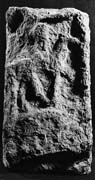
Object type: Part of cross-shaft [1]
Measurements: H. 56 cm (22 in) W. 29 > 26 cm (11.4 > 10.2 in) D. 20 > 17 cm (7.9 > 6.7 in)
Stone type: Very micaceous sandstone, bedding parallel to the main face, medium-grained, poorly sorted, feldspathic. This flagstone has a yellow colour (10YR 7/4), which has been surface modified by burning to a brown colour (7.5YR 5/4). Local to the site, Brigantian, Lower Carboniferous
Plate numbers in printed volume: Ills. 1104–7
Corpus volume reference: Vol 6 p. 269-270
(There may be more views or larger images available for this item. Click on the thumbnail image to view.)
A (broad) : The surface, including the edge moulding is almost weathered away. Vestiges of a wide moulding survive at the top and right-hand side framing the figure of a horseman. Horse and rider are shown in profile but the details are very indistinct. The rider appears to be bearded and to hold a round shield at his right side. His torso is unnaturally shortened, and, if the bar-like feature between the horse's legs is his leg, this is unnaturally large. The horse has a small head with pricked-up ear and is shown in motion with one front leg raised and the others extended, striding up a rounded mound which fills the lower part of this face. Beneath it the stone is cut back at an angle.
B (narrow) : Filled with a four-stranded plain plait with well-rounded strands.
C (broad) : Traces of a heavy cable moulding survive, and the face is filled with a bold four-stranded plait with wide intersections between the strands.
D (narrow) : As face B.
The figure of the horseman was already very indistinct in the eighteenth century, as Tunstall's drawing indicates (Cowen and Barty 1966, pl. V, fig. 2), although more of the left edge moulding survived. The relationship of the rider to the humped feature is however wrongly depicted by Tunstall, and the curious tentacle-like features which he shows at the base of the 'hump' are not visible today.
Mounted figures, often bearing arms, seem to be a type which occurs associated with Viking-age ornament, and several examples are found at sites along the Tees valley: Stanwick 1 (Ill. 752), Gainford 4, Sockburn 3 and 14 (Cramp 1984, pls. 61, 290; 130, 710 and 139, 745), as well as further north in co. Durham at Chester-le-Street 1 and Hart 1 (ibid., pls. 20, 102 and 79, 394). The occurrence of this figure type at Wycliffe is not only an indication, as are the hogbacks nos. 5 and 6, that the burial ground continued in use into the Viking Age, but illustrates the orientation of this site towards the Tees valley. It has been suggested by Cambridge that Wycliffe was a dependency of Gainford (1984, 76). It was certainly one of the two landholdings of the Chester-le-Street based Community of St Cuthbert south of the Tees, and nos. 1, 8 and 9 indicate that before that time it may have been a significant ecclesiastical site.
