Select a site alphabetically from the choices shown in the box below. Alternatively, browse sculptural examples using the Forward/Back buttons.
Chapters for this volume, along with copies of original in-text images, are available here.


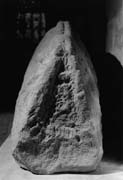
Object type: Part of hogback [1]
Measurements: L. 111.8 cm (44 in) W. 31.7 > 25.4 cm (12.5 > 10 in) H. 53.3 > 38.1 cm (21 > 15 in)
Stone type: As no. 3 except that this stone has been burnt to a pink colour (7.5YR 6/4).
Plate numbers in printed volume: Ills. 1123–6
Corpus volume reference: Vol 6 p. 271-272
(There may be more views or larger images available for this item. Click on the thumbnail image to view.)
The ridge is a double cable issuing from the jowl of the end-beast.
A (long) : Beneath the ridge are three rows of type 2b tegulae, though some are almost type 7. Below are the remains of two raised panels which contain the tops of interlace patterns, probably the bar terminals of simple twist. From their position a third panel may be postulated. They are separated by plain recessed areas of equal dimensions. The lower part of the face has been destroyed.
The end-beast is stylised. Its head is small with gaping jaws and fangs. Though naturalistic, its body exists only as a complicated knot, which is divided into an upper and lower panel separated by the eaves. The upper one has the head, with pointed ears touching the roll moulding of the gable edge. The jowl has drilled nostrils and incised circular eyes. The jaws are hinged by a loop through which passes a curving band which crosses the eaves and joins the knotwork of the lower panel. Below the jaw loop is a flat horizontal strand. The lower panel has two pattern F loops linked by a split strand descending from the jawline, resembling vertebral ring-chain. (Collingwood's drawing of this face is very poor.)
B (end) : The gable end is triangular in section and plain within the roll moulding, except for a pellet at the apex.
C (long) : Similar to face A, but the threading of the jaw loop is clearer on this side, and the two surviving interlace panels contain the terminals of four-cord plait.
D (end) : Broken away.
This is a type b hogback, the pilaster variety. Whilst this is clearly a development of the panel type (type a), its distribution is much wider, suggesting that the idea of end-beast hogbacks spread westwards from Allertonshire: Wycliffe 5, Lowther 6 (Bailey and Cramp 1988, ills. 452–5), Aspatria 6 (ibid., ills. 35–7), and north to Inchcolm in Scotland (Lang 1972–4, pl. 15c). The plaits are cut upon raised panels, with the intervening spaces recessed, giving the effect of ornamental pilasters. The end-beasts of this type have become vestigial, and the Wycliffe animal shows the transition from the naturalism of the early types to the abstraction of the later versions: the head is realistic but the body is a mere knot, and the end of the stone is purely architectural. The richer ornament and the developed beasts indicate a later date in the series than type a (Lang 1984a, 99).
