Volume 6: Northern Yorkshire
Select a site alphabetically from the choices shown in the box below. Alternatively, browse sculptural examples using the Forward/Back buttons.
Chapters for this volume, along with copies of original in-text images, are available here.
Current Display: Wycliffe 06, Yorkshire North Riding


Overview
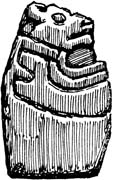
Object type: Hogback fragment [1]
Measurements: (after Collingwood 1907) H. 38 cm (15 in) W. 24 cm (9.5 in) D. 24 cm (9.5 in)
Stone type: Not recorded
Plate numbers in printed volume: Ill. 1122
Corpus volume reference: Vol 6 p. 272
(There may be more views or larger images available for this item. Click on the thumbnail image to view.)
Present Location
Lost? 'Despite an extensive search in and about the church which was being restored (in April 1963) it was not to be found' (Lang 1967, 155). 'Now missing' (Morris, C. 1976a, 145).
Evidence for Discovery
See Wycliffe 3 (St Mary). In the rectory coach-house in 1905 (Collingwood 1907), and still at the rectory in 1930 (Morris, J. 1931). Apparently moved to the church by 1936, together with no. 5 (Pontefract and Hartley [1936]).
Church Dedication
St Mary
Present Condition
Unknown
Description
Collingwood's record is all that remains. 'The bear's head is apparently the end of a hogback differing from the Brompton type ... It is solidly carved, the surfaces flat, with deep incisions to mark detail. The other side is somewhat defaced, but has a bit of step pattern' (1907, 413).
Discussion
The end-beast of a hogback, indeterminate type. Collingwood's illustration shows a stylised end-beast, but its head appears to be naturalistic and without a muzzle. The jaws are closed. The broad sweeping ribbon, curling at the end, is reminiscent of the ornamentation on Brompton 26 (Ill. 107).
Date
First half of tenth century
References
Collingwood 1907, 271, 276, 293, 413, fig. a on 412; Partington 1909, 130; Collingwood 1912, 116, 128; Collingwood 1915, 284; Collingwood 1927a, 169; Wall 1930, 51; Morris, J. 1931, 413; Pontefract and Hartley [1936], 152; Lang 1967, 155–6, fig. 45; Morris, C. 1976a, 145; Morris, C. 1976b, 11; Lang 1984a, 168, no. 2
Endnotes
[1] The following are general references to the Wycliffe stones: Bulmer 1890, 635; Hodges 1894, 195; (—) 1929–30, 60; Morris, J. 1931, 413; Mee 1941, 263; Cowen and Barty 1966, 65; Pevsner 1966, 403; Cambridge 1984, 76; Cramp 1989, 215n; Cramp 1992, 331n.