Select a site alphabetically from the choices shown in the box below. Alternatively, browse sculptural examples using the Forward/Back buttons.
Chapters for this volume, along with copies of original in-text images, are available here.


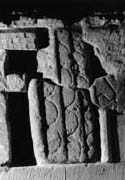
Object type: Part of coped grave-cover, in two fragments
Measurements:
a: L. 24 cm (9.5 in) W. 26 > 16 cm (10.2 > 6.3 in) D. Built in (6.5 in, according to Collingwood 1907)
b: L. 35 cm (13.8 in) W. 29 > 27 cm (11.4 > 10.6 in) D. Built in
Stone type: Medium-grained, well sorted sandstone, grains sub-angular. Bedding planes visible parallel to the front (worked) face. This rock has been bioturbated, with limonitic concentrations. Yellow (2.5YR 7/6). Upper Carboniferous (Westphalian) sandstone, probably from the south Durham area
Plate numbers in printed volume: Ill. 1186
Corpus volume reference: Vol 6 p. 290
(There may be more views or larger images available for this item. Click on the thumbnail image to view.)
'Found on the site of the grammar school in the present churchyard' (Collingwood 1907, 413): this building, which lay south-east of the church, was demolished in 1884 (Wardell 1957, 95). Loose at east end of south aisle when noted by J. Morris (1904) and Collingwood, who only describes and illustrates fragment a.
Parts of two rows of incised semicircular tegulae, type 6, survive below the roll-moulded ridge on fragment b. These possibly change to triangular type 7 on the very damaged third row. The ridge and upper row are dressed off on fragment a.
Appendix A item (stones dating from Saxo-Norman overlap period or of uncertain date).
Not a hogback. The tegulation types are common on Romanesque coped covers in the region and in co. Durham (Lang 1974b, 101). Several such monuments are found at Yarm (see Heslop 1990, 41–2). A post-Conquest piece.
