Select a site alphabetically from the choices shown in the box below. Alternatively, browse sculptural examples using the Forward/Back buttons.
Chapters for this volume, along with copies of original in-text images, are available here.


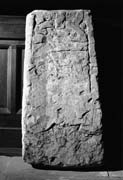
Object type: Part of shaft
Measurements: H. 87 cm (34.25 in) W. 43.2 > 38.5 cm (17 > 15.2 in) D. 16 > 14 cm (6.3 > 5.5 in)
Stone type: Fine-grained, micaceous, feldspathic sandstone with rounded grains. This stone is slightly calcareous. Prominent bedding planes can be seen parallel to the front face and this sandstone contains mudflake clasts up to 10mm in size. Reddish brown colour (5YR 5/4). This poor quality fluviatile sandstone is characteristic of Permo-Triassic sediments (Sherwood Sandstone Formation) found exposed in the river Tees valley in the Croft area.
Plate numbers in printed volume: Ills. 153–4, 157–8
Corpus volume reference: Vol 6 p. 92
(There may be more views or larger images available for this item. Click on the thumbnail image to view.)
A (broad) : A broad plain edge moulding flanks a very worn panel. Near the base are faint remains of interlace in broad flat strand. Near the top is a broad transverse moulding above which is a vertical strand that splits into a return loop through the lower half of a ring. On the lower right is a large pellet filler. More worn ones fill the angles of the return loop.
B (narrow) : Plain for most of the lower part. Between plain edge mouldings near the top is a bar terminal and one register of a ring-twist with a glide to the next register.
C (broad) : As face A but more damaged. Only the lower part of the interlace at the top of the face remains, but there is no pellet filler in the surviving return loop.
D (narrow) : Between broad edge mouldings in the upper half is a plain panel that erupts into ring-twist with a glide to the second incomplete register.
The ring-twist and the return loop, which may have been part of a ring-knot like those on the hogbacks at Gosforth and Govan (Bailey and Cramp 1988, 105, ill. 322; Lang 1972–4, 211–13, fig. 3), are typical of the Anglo-Scandinavian repertoire. The break at the top may have been a cut. Whilst simple in design, the cutting is well organised.
