Select a site alphabetically from the choices shown in the box below. Alternatively, browse sculptural examples using the Forward/Back buttons.
Chapters for this volume, along with copies of original in-text images, are available here.


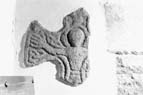
Object type: Part of cross-head [1]
Measurements: H. 36.3 cm (14.3 in) W. 30 cm (11.8 in) D. Built in
Stone type: As Finghall 1 (St Andrew), but this cross-head contains pebbles up to 200mm in size.
Plate numbers in printed volume: Ill. 244
Corpus volume reference: Vol 6 p. 107-108
(There may be more views or larger images available for this item. Click on the thumbnail image to view.)
A type E10 free-armed cross-head with curved tip to the arm and widely curved arm-pits. The edge moulding is neat and modelled, extending round the splayed arm. The centre is occupied by a Crucifixion, the haloed head filling the base of the upper limb and surmounted by a pair of pellets, and perhaps a cross-shaped filler. Christ's waist is slender and is crossed by a narrow band which links with flanking strands that fill the space between the figure and the edge moulding. On the left-hand surviving limb, Christ's arm is raised from a slightly dipped elbow, the splayed hand expanded out of all proportion. Beneath the hand is a triquetra in narrow strand, a pellet lies above the thumb, and a loose interlace filler rests above the arm. The pear-shaped head is fairly well modelled; the nimbus flat. The cutting is punched work.
The position of the Crucifixion on the cross-head is probably an Irish-derived custom, frequent among North Riding crosses of the Anglo-Scandinavian period (see Chap. V, p. 37). The filling devices suggest the same milieu, though the cross form is an Anglian survival. The ring-heads did not supplant the free-armed types.
