Select a site alphabetically from the choices shown in the box below. Alternatively, browse sculptural examples using the Forward/Back buttons.
Chapters for this volume, along with copies of original in-text images, are available here.


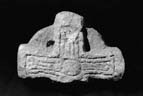
Object type: Cross-head [1]
Measurements: H. 23.7 cm (9.3 in) W. 34.7 cm (13.7 in) D. 11 cm (4.3 in)
Stone type: As Finghall 1 (St Andrew), except that the rock colour is partly masked by lime mortar.
Plate numbers in printed volume: Ills. 245–9
Corpus volume reference: Vol 6 p. 108
(There may be more views or larger images available for this item. Click on the thumbnail image to view.)
A (broad) : A type A1 cross-head; the arm-pits are right angled and the squared arms straight-sided. The ring, type (a), is recessed and the piercings at the arm-pits are not cut through. The upper limb is damaged. The edge moulding is roughly cut and varies in width. Within each lateral arm are narrow horizontal strips; on the left-hand arm the strands join in a circle which seems to contain a crosslet. In the upper limb are four similar vertical strips. In the centre is an incised roundel. The ring is undecorated.
B (narrow) : The arm-tip has a flat narrow edge moulding forming a square panel which contains an incised saltire.
C (broad) : The upper arm is defaced but three strips project from it down the centre of the cross-head, and on either side are two incised projections which terminate in fringe-like features.
D (narrow) : As face B.
E (top) : Damaged.
This is a crudely carved piece, but has obvious similarities with Wath 5 where the lateral arms are similarly decorated (Ills. 853–7). Coatsworth has rejected this as a Crucifixion (1979, II, 74), but it is possible that these carvings are a remote invocation of Crucifixion motifs, whilst the prominent circle on face A can be compared with the position of the Host on Stanwick 7 (Ill. 768) and Thornton Watlass 1 and 2 (Ills. 812, 813). The encircled crosslet on face A occurs also on Stainton 4 (Ill. 748), reinforcing the impression that there was a local school of carvers in this area who shared the same repertoire of motifs and the same crude standards of workmanship.
