Select a site alphabetically from the choices shown in the box below. Alternatively, browse sculptural examples using the Forward/Back buttons.
Chapters for this volume, along with copies of original in-text images, are available here.


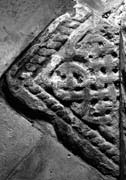
Object type: Part of a grave-cover
Measurements: 40 cm (16 in) x 35 cm (14 in); D. Built in
Stone type: Very heavily patinated block with no really fresh surface — yellowish grey (5Y 7/2), poorly sorted, shelly oolite with ooliths standing proud. Ooliths mostly in the range 0.4 to 0.6 mm diameter; clasts up to 2.5 mm across. ?Osmington Oolite, Corallian Group, Upper Jurassic [1]
Plate numbers in printed volume: Pl. 170
Corpus volume reference: Vol 7 p. 135
(There may be more views or larger images available for this item. Click on the thumbnail image to view.)
Corner fragment of a grave-cover now reused as part of the floor and supporting a late medieval door jamb. It has a flat-band outer moulding and inner cable, enclosing two rows of figure-of-eight knots (simple pattern F). The strands are median-incised and precisely cut and gridded.
Such grave-covers are well known in Lincolnshire and the East Midlands (Everson and Stocker 1999, 50–7, fig. 14) where, in their complete form, they are rectangular with little taper and decorated with the same pattern of rows of figure-of-eight knots. The strands are not usually median-incised in that area, however, but such knots are found in the south-west on shafts such as Ramsbury 1 and Teffont Magna in Wiltshire (Ills. 489, 517–18), and Colyton and Dolton in Devon (Ills. 6, 20, 22), and on these monuments the strands are incised. Despite the fact that this is the only grave-cover of this type found in the south-west, since the stone type seems to be local this piece does not appear to be an import, but a reflection of a period fashion. Foster (1987, 71) saw the interlace as a 'basket-weave', but the figure-of-eight knots are a very common type, both on this form of monument nationally (Cramp 1991, fig. 23) and on all types of monument in the region.
