Select a site alphabetically from the choices shown in the box below. Alternatively, browse sculptural examples using the Forward/Back buttons.
Chapters for this volume, along with copies of original in-text images, are available here.


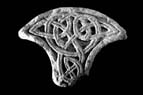
Object type: Cross-arm
Measurements: H. 28 cm (11 in); W. 37.5 cm (14.5 in); D. 14.5 cm (5.75 in)
Stone type: Greyish yellow (5Y 8/4), poorly sorted, matrix-supported, sparsely shelly oolite. Ooliths 0.3 to 0.6 mm diameter weather out to give 'aero-chocolate' texture. Shell fragments platy and up to 5 mm across, and sub-angular to sub-rounded — perhaps forming 10 % of the rock. A very few spindle-shaped bioclasts — ?bryozoa. Bath stone, Chalfield Oolite Formation, Great Oolite Group, Middle Jurassic
Plate numbers in printed volume: Pls. 175-6
Corpus volume reference: Vol 7 p. 141
(There may be more views or larger images available for this item. Click on the thumbnail image to view.)
A (broad): One arm of a fan-armed crosshead with a plain roll moulding enclosing deeply cut median-incised interlace. There is a simple pattern A knot at the narrowest part, and a complex knot which consists of two turned and conjoined pattern A knots crossed by two diagonals which neatly fill the corners of the arm with pointed loops.
B and D (narrow): Plain
C (broad): This face is very abraded and the interlace pattern only survives at all at the terminal. The pattern is more complex than that on face A, and the strands are spiralled.
This is a very clever design to fill the space, and the carver had enough confidence to find two different ways of terminating his pointed loops. The result is a flexible, deeply-cut pattern which shares some of the characteristics of Bath 3 (Ills. 173–4), and they must be products of the same workshop.
Bath was an important monastic centre, first as a 'monastery for holy virgins' as stated in its foundation charter of AD 675 (see Sims-Williams 1990, 34, 110, 120), and then by 758 had become an all male community. The fact that it was on the border between Wessex and Mercia and was ceded to Offa's royal control at the Synod of Brentford in 781 (ibid., 159) helps to explain the excellent, almost geometric gridded interlace of these cross-heads which is unusual in Wessex. Although this piece has been associated with St Aldhelm by some commentators such as Forrest Browne, there is no need to put it earlier than the eighth century (see also introduction pp. 1–2, 4, 6, 9, for the background to this monastic centre).
