Select a site alphabetically from the choices shown in the box below. Alternatively, browse sculptural examples using the Forward/Back buttons.
Chapters for this volume, along with copies of original in-text images, are available here.


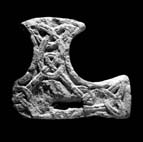
Object type: Cross-head
Measurements: H. 31 cm (12 in); W. 36 cm (14 in); D. 9 cm (3.5 in)
Stone type: Greyish yellow (5Y 8/4), poorly sorted, sparsely oolitic limestone. Ooliths 0.3 to 0.8 mm diameter, but mostly in the range 0.3 to 0.5 mm. Ooliths weather out to give 'aero-chocolate' texture; a few ?limonitised ooliths stand proud. Shell fragments platy or sub-rounded and up to 2.5 mm across; 1 byozoan fragment. Bath stone, Chalfield Oolite Formation, Great Oolite Group, Middle Jurassic
Plate numbers in printed volume: Pl. 173-4
Corpus volume reference: Vol 7 p. 140-1
(There may be more views or larger images available for this item. Click on the thumbnail image to view.)
One vertical and one horizontal arm of a cross-head, type E10, the vertical arm tip more splayed than the horizontal. The shape is outlined by a flat band. As displayed, the widest arm tip is shown as horizontal (see also Foster 1987, fig. 12c); but the orientation chosen here seems more convincing.
A (broad): The centre of the head is very damaged, with a deep cut into the central roundel which may have been petalled or beaded. Two median-incised strands surround it and form a pattern A knot, followed by a pattern E knot which fills the terminal of the arms.
B and D (narrow): Plain
C (broad): This side is even more damaged at the centre than face A, but a pattern E knot survives at each arm tip and part of a pattern A knot at the base of the vertical arm.
The rounded and expanded terminals to the arms of this cross are typical of the region (see introduction p. 36, and Fig. 18), occurring as far east as Pagham, Sussex (Tweddle et al. 1995, ills. 98–100), which, like the more elegant example from Amesbury (no. 1, Ills. 383–7), is a ring-head. The free-armed head here, like those from Bradford-on-Avon (no. 2, Ill. 400) and Keynsham (no. 6, Ill. 289), could be earlier.
