Select a site alphabetically from the choices shown in the box below. Alternatively, browse sculptural examples using the Forward/Back buttons.
Chapters for this volume, along with copies of original in-text images, are available here.


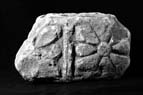
Object type: Part of a cross-arm
Measurements: H. 15 cm (6 in); W. 25 cm (10 in); D. 16 cm (6.25 in)
Stone type: Very pale yellowish-grey oolitic limestone (10YR 8/1–2), with a calcite matrix pitted by the vacant sockets of ooliths around 0.4mm in diameter (range 0.4 to 0.6mm). Two short calcite veinlets are to be seen on the concave inner surface of the fragment at right angles to its flat carved faces. Bath stone, Chalfield Oolite Formation, Great Oolite Group, Middle Jurassic [1]
Plate numbers in printed volume: Pls. 177-80
Corpus volume reference: Vol 7 p. 142
(There may be more views or larger images available for this item. Click on the thumbnail image to view.)
It is not certain which arm of the cross this is, side or upper. I have assumed it is the upper arm.
A (broad): Most of the surrounding moulding is lost. The scroll is very worn, watermarked and chipped. This appears to be a plant-scroll with one tendril terminating in a single berry, the volute enclosing a tendril with possibly a single flower or leaf. There may have been other small triangular leaves at the top and side. Width of strand c. 2 cm.
B (narrow): Curved and smoothly dressed but plain, with a deep chip.
C (broad): None of the roll moulding survives, and the right-hand side of the knot is chipped off. Well-moulded, rounded strands 2 cm wide form a knot.
D (narrow): Partly chipped off but plain curved surface.
E (top): Surrounded by a roll moulding and divided by a median-incised band. One panel contains a battered eight-petalled flower about 13 x 10 cm wide, with a rounded centre; the flower is quite cleverly designed with the four corner petals pointed and the intermediate petals rounded. The flower in the other panel is almost worn away but three petals and the centre survive.
This must once have been a richly decorated piece, and despite its shape and interlace which is congruent with the other cross-heads, Kendrick was surely correct in seeing something of a northern influence. The plant-scroll is reminiscent of Crayke, Yorkshire (Lang 2001, ills. 145–6) as well as Otley as he suggested (Kendrick 1941, 76; see Collingwood 1927, fig. 52). Kendrick also stressed the 'insistent classicism' of the flower motif, and this is indeed more like a Roman than Anglo-Saxon inspiration. Kendrick dated this piece to the early ninth century, but it seems reasonable to see this as a production when Bath was closely linked with Northumbria and Mercia in the eighth century.
