Select a site alphabetically from the choices shown in the box below. Alternatively, browse sculptural examples using the Forward/Back buttons.
Chapters for this volume, along with copies of original in-text images, are available here.


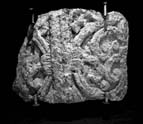
Object type: Part of a grave-cover
Measurements: L. max. 32 cm (12.5 in); W. at base 44 cm (17.25 in); D. in centre 11 cm (4.25 in)
Stone type: Medium-grained, poorly sorted, sparsely shelly oolite, with ooliths weathering out to give 'aerochocolate' texture. Ooliths range from 0.3 to 0.6 mm diameter, but mostly are between 0.4 and 0.5 mm. Shell fragments, mostly platy, vary from sub-angular to subrounded and up to 3 mm across. Bath stone, Chalfield Oolite Formation, Great Oolite Group, Middle Jurassic
Plate numbers in printed volume: Pls. 183-5; Fig. 22m
Corpus volume reference: Vol 7 p. 142-3
(There may be more views or larger images available for this item. Click on the thumbnail image to view.)
Only the upper face is carved. The piece is coped, and divided at the centre by a double moulding with tiny indented triangles in between. Clipped to this central ridge by pairs of rounded 'clips' are volutes of plant-scroll, only one of which is complete. Within each volute are three large curling leaves; single or double small pellets fill the spaces around the leaves.
Although reused, this cover is reasonably considered to be a monument from the Saxon cemetery, which has provided radiocarbon dates of the ninth to tenth century. This type of coped grave-cover has quite a wide distribution in the south-west (see introduction p. 32), and in this region is to be found at Wells (no. 1, Ill. 327) with a close relation at St Oswald's, Gloucester (West 1984b, 43, ill. 24), but the organisation and detail of the plant-scrolls are different. Here the swirling acanthus leaves with lobed tips, the paired clips (which Plunkett called 'domed brackets' (1984, I, 210); see introduction p. 51), and the loose pellets are very like the lower Todber shaft (Ills. 110–13), whilst the distinctive 'clips' are also found attaching plants (of a different type) at Iron Acton, Gloucestershire (Plunkett 1984, II, pl. 86) and Nunney (Ill. 316). This seems then to be a local variant of a more generalised form of grave monument. Its carving is crisp and confident and when complete it must have been a striking piece, marking an important grave.
