Select a site alphabetically from the choices shown in the box below. Alternatively, browse sculptural examples using the Forward/Back buttons.
Chapters for this volume, along with copies of original in-text images, are available here.


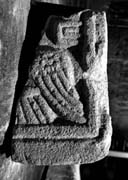
Object type: Lower arm of a cross(?)
Measurements: H. 19 cm (7.25 in); W. 14 < 17.25 cm (5.5 < 7 in); D. max. 11 cm (4.5 in)
Stone type: Yellowish grey (5Y 8/1), medium grained, shelly, matrix-supported oolite with most of the ooliths weathered out to give an 'aero-chocolate' texture. Ooliths mostly in the range 0.3 to 0.6 mm; some shell fragments up to 3 mm across. Bath stone, Chalfield Oolite Formation, Great Oolite Group, Middle Jurassic
Plate numbers in printed volume: Pls. 188-96
Corpus volume reference: Vol 7 p. 143-4
(There may be more views or larger images available for this item. Click on the thumbnail image to view.)
A: The face is edged with wide flat bands. An acanthus scroll, in which the central median-incised stem springs from a double rounded base, and sprouts two pairs of curling lobed acanthus leaves.
B (if correctly oriented, D as mounted): Part of the wide edge moulding survives, enclosing an indeterminate coiled feature with an incised fork or rune-like character in the centre.
C: Broken away
D (if correctly oriented, B as mounted): Set in a narrow rolled frame within the outer border is part of a creature with wings and tail. There are clips at the side of the frame.
F (base as originally formed, E as mounted): A deep triangular break and a modern rectangular cut
When discovered, Irvine described and drew it as the broken arm of a ring-headed cross which had been held together by an iron cramp. 'A fragment of a fine churchyard cross of rich Norman work was found on the 20th. It is the lower arm, and bears part of the eagle, the emblem of St John, and the circle which united the arms' (Irvine notes, quoted in Holland and Chapman 1990, 27). The two-light opening (Bath 8) was found near it. A Norman date is still tentatively assigned to this piece by Holland and Chapman, but without detailed discussion. The ring enriched with dotted circles as drawn by Irvine (Ill. 191) is now missing and it is uncertain when this was broken off, or from where. The wing tip as drawn by Irvine is now missing, but the surviving details which he did record are very accurate. He is certainly correct in saying that if this were a cross-arm it must have been the lower vertical arm in order to make sense of the acanthus ornament and the winged creature. The reason that this creature has been considered to be a bird / eagle, rather than another Evangelist symbol or an angel, seems to rest solely on the apparent tail: a position for the eagle on the upper arm is more common in depictions of the Lamb surrounded by Evangelist symbols in tenth- to eleventh-century English art, a date to which this piece could be ascribed through its acanthus ornament, which has much in common with Littleton Drew (Ills. 455–8). Irvine's accurate depiction of the acanthus includes a 'clip' attached to the frame, a feature which is a hallmark of the sculpture of Wessex in this period (see introduction p. 51). This is a very important piece, and it is more elaborate than any of the other surviving crosses from the region, and unique in the iconography of the head.
