Select a site alphabetically from the choices shown in the box below. Alternatively, browse sculptural examples using the Forward/Back buttons.
Chapters for this volume, along with copies of original in-text images, are available here.


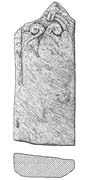
Object type: Slab (possibly coffin lid)
Measurements: L. max. 64 cm (25.25 in); W. 28 cm (11 in); D. max. 5 cm (2 in)
Stone type: [Bath stone]
Plate numbers in printed volume: Pl. 197
Corpus volume reference: Vol 7 p. 144
(There may be more views or larger images available for this item. Click on the thumbnail image to view.)
A (broad): Most of the face is plain and the carving may be unfinished. There is an incised line marking a border on one edge and the faint remains of a plant-scroll with curling tips at the top.
B–F: The other faces are plain.
This has the appearance of an unfinished carving, or one that has been adapted. If this is a coffin cover, as opposed to a recumbent slab, then it is unique in this region, and such covers are more common in the post-Conquest period. The plant ornament however has a strong relationship to the late West Saxon treatment of acanthus, and we have an example of such plant forms on Bath 9 from this site (Ill. 189).
