Select a site alphabetically from the choices shown in the box below. Alternatively, browse sculptural examples using the Forward/Back buttons.
Chapters for this volume, along with copies of original in-text images, are available here.


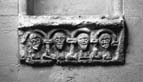
Object type: Probably a piscina
Measurements: H. 20 cm (8 in); W. 41.cm (16 in); D. 33 cm (13 in)
Stone type: [Not seen]
Plate numbers in printed volume: Pl. 357
Corpus volume reference: Vol 7 p. 183
(There may be more views or larger images available for this item. Click on the thumbnail image to view.)
Rectangular trough with a central drain. Decorating the outer face is an arcade formed of four semi-circular arches supported on rectangular imposts and with shafts inset into block-like bases. There are the vestiges of plain flat frames at the sides and a rounded projecting ridge above, which has been badly scarred. Within each arcade is a bust with oval face, prominent protruding eyes and small pursed mouth. The heads are supported on concave wedge-shaped blocks. There are traces of gesso and red paint.
Appendix A item (stones dating from Saxo-Norman overlap period or of uncertain date).
These bizarre heads have some family likeness to the figure in a shell canopy at Bath (no. 12, Ill. 356) and the figures on the Yetminster shaft (Ills. 153–8) and on Dolton 1a, face A (Ill. 20). The emphasis on the heads alone as encapsulating the being may be a folk survival from the British heads such as those from northern sites or from Gloucester (Kendrick 1938, pls. IV and IX). Whether within this context they are meant to represent the four Evangelists or are prophylactic is impossible to say. The block capitals and imposts would not be out of keeping in a pre-Conquest context; see Bradford-on-Avon, St Laurence's church (Ills. 549, 551).
