Select a site alphabetically from the choices shown in the box below. Alternatively, browse sculptural examples using the Forward/Back buttons.
Chapters for this volume, along with copies of original in-text images, are available here.


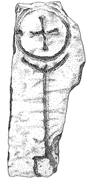
Object type: Cross-slab
Measurements: H. 131 cm (51.5 in); W. 34 < 54 cm (13.5 < 21.25 in); D. c. 18 cm (7 in)
Stone type: [Dartmoor Granite]
Plate numbers in printed volume: Pls. 41–2
Corpus volume reference: Vol 7 p. 90-1
(There may be more views or larger images available for this item. Click on the thumbnail image to view.)
Appendix A item (stones dating from Saxo-Norman overlap period or of uncertain date).
Having failed to locate this stone on a visit to Belstone, this account is based on the excellent drawings provided by Susan Levy (Levy 2004, figs. 5, 6).
A (broad): The surface of the stone has not been smoothly dressed, but neatly incised into its surface is a cross with slightly wedge-shaped arm terminals (type B1) surrounded by a circle 40.5 cm in diameter. Below the circle is a vertical stem terminating in a roughly rectangular base, of which only the left-hand side survives, curving inwards at the foot. The top of the stem is crossed by an arc which cups the circle above and roughly follows its outline. Levy records that the design 'has been cut to a "V" shaped profile, with a depth varying between 0.5 and 1.5 cm', and that the width of the cutting of the cross is 2–3 cm; of the enclosing circle and arc 3–3.5 cm, and of the stem c. 4 cm (Levy 2004, 7).
B (narrow): Plain, part of the rounded edge is weathered and may be original, the rest damaged and broken.
C (broad): Plain, worn smooth by use as a step
D (narrow): Plain and recut with some tool marks
E (top): Broken away
F (base): Partly retooled and partly broken
This slab has been trimmed from its original shape and is relatively thin, and so it is just possible that it was originally recumbent. It seems more likely however that it was originally set vertically, like other incised shafts and slabs from western Britain (see Appendix H, p. 245, and Nash-Williams 1950). It is unlike the British crossincised slabs, however, in several details of the ornament. There are parallels for incised crosses with long stems and encircled heads in Wales, for example at Llanfyrnach or St David's (Nash-Williams 1950, fig. 5; no. 319, pl. I; no. 372, fig. 232; see also examples quoted by Levy 2004, 13), and incised crosses in circles also are found on the supposedly earliest group in the Isle of Man, at Lonan Old Church and Maughold (Kermode 1907, 104–5, pl. VII). The slightly wedge-shaped arms of the encircled cross at Belstone are not a feature of Welsh crosses, however, although the form, often encircled, is found on many Merovingian sarcophagi (Fossard, Vieillard-Troiekouroff and Chatel 1978, pls. VI, VIII–XV, etc.), and (probably reflecting continuing contact between Christians in France and the western seaways) on the stones from Kirkmadrine in south-west Scotland (R.C.A.H.M.S. 1912, figs. 93, 94), as well as in large numbers on cross-incised slabs in Ireland (see below).
There are other features which are difficult to parallel in mainland Britain: a) the cross floating free in the circle; and b) the curving top of the shaft which cups the circle from below. The only cross in the Welsh series with a partly enclosing outer ring is Mathry, Rhoslanog Farm (Nash-Williams 1950, no. 348, fig. 220) but that is above the circle. Where there is a base on the Welsh shafts, as at Newport and Port Talbot (ibid., no. 262, pl. LVII; no. 362, fig. 227), it curves upwards, as do the bases of several Irish incised crosses, whilst the stem of the Belstone piece seems to me more meaningfully set in a base.
The distinctive features of this Belstone carving are however found on some cross-incised slabs in western Ireland, especially in the Dingle peninsula: for example, the cross-slab no. 2 from Lateevemore (Cuppage 1986, 330–1, fig. 199) has a cross with wedge-shaped terminals which floats free in a circle, with below it another cross with a long stem and crescent-shaped foot, and here the upper vertical arm of the lower cross has an extended terminal which cups the circle enclosing the cross above. Encircled crosses with wedge-shaped terminals for the arms are also found at other early ecclesiastical sites here such as Ballymorereagh (ibid., fig. 151), most probably as burial monuments, but at all of the sites there is a long period of burial and in the case of the most extensively excavated site, Reask, the excavator considered that it extended from the fourth to the twelfth century (Fanning 1981, 160). It is quite possible that the Belstone incised slab belongs to the earliest Irish Sea influences in this region, but its date is not certain and, like similar slabs in Ireland, a very wide bracket is to be preferred (Cuppage 1986, 258).
The development from a Chi-Rho monogram encircled by a wreath to the simple cross in a circle has been widely discussed (see Thomas 1971, 106–10, figs. 49, 50), and seems to be without doubt the origin and significance of the encircled cross such as this at Belstone. Whether the outer ring also had a Christian meaning is more open to debate when one considers the cross-bars and flourishes which embellish the stems of the Irish incised crosses.
