Select a site alphabetically from the choices shown in the box below. Alternatively, browse sculptural examples using the Forward/Back buttons.
Chapters for this volume, along with copies of original in-text images, are available here.


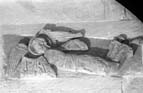
Object type: Two figures of angels [1]
Measurements:
(after Coatsworth 1979, II, 14)
a: Left (right-facing); H. 61 cm (24 in); L. 106.8 cm (38 in); D. Built in
b: Right (left-facing); H. 53.4 cm (21 in); L. 111.8 cm (40 in); D. Built in
Stone type: Inaccessible, but each stone appears to be a monolith of grey to pale orange oolitic limestone. Probably Bath stone
Plate numbers in printed volume: Pls. 404-6
Corpus volume reference: Vol 7 p. 203-4
(There may be more views or larger images available for this item. Click on the thumbnail image to view.)
Discovered embedded in the wall above the chancel arch, west face, during repairs to the schoolroom c. 1850 (Dryden 1906b, 217), but in 1856-7 removed for the insertion of a flue; 'and for some time were placed over the porch leading to the modern house attached to the building on the south side' (Jones 1875, 144, and see also Jones 1858, 249; Jones 1872a, 7).
Both angels are carved in high relief from single blocks of stone which taper from the head to the feet. The two angels face each other and both are depicted with their bodies extended in a horizontal position with their heads facing forward and legs kicked up behind. Their wings frame their faces, one extended behind and one drooping over their outstretched hands which are covered by cloths, whilst a flying fold of drapery fills the space between the upper wings and the backs of each angel. Both heads are haloed and the hair is covered by a cloth which also covers the neck and is held in place by a band. There are minor differences in the details, not only of the measurements but of the wing decoration and of the garments: the folds of the garment of the right-facing angel (a) outline the hip and are gathered round the bent knees, whilst the hem of its drapery fans out in delicate frilly folds (Ill. 404); the garment of the left-facing angel (b) is tied with a more prominent fold around the waist, and a series of incised crescents indicate the body folds. The skirt of the garment has a prominent curled hem line, and an attempt has been made to show the outline of the legs through the drapery (Ill. 405). The right-facing angel (a) is the more damaged: whereas the hands of the left-facing (b) are covered by a pleated napkin which falls realistically over the raised hands, the hands of (a) are covered by a rough block with angular striations which is either unfinished or has been positioned as a replacement. The wings on angel (a) are also less detailed and do not distinguish the primary from the secondary feathers. It is possible that, although following the same formula, the angels were carved by different hands.
All commentators have seen these angels as part of a Crucifixion composition, with a central crucifix and probably Mary and John at the foot, such as is found in late Anglo-Saxon manuscripts. The angels are most closely paralleled in the Sherborne Pontifical, fol. 4v (Temple 1976, no. 35, ill. 134) and the Arenberg Gospels, fol. 9v (ibid., no. 56, ill. 171), both of which are dated to c. 990–1000. The Bradford angels have a stately sculptural quality, comparable with the angel at Winterbourne Steepleton, Dorset (Ills. 149–52), but the details of drapery folds and wings appear to be inspired by manuscript techniques such as those in the Arenberg Gospels in particular. Interestingly, however, Barbara Raw says, 'It seems likely that the Arenberg/Sherborne iconography was an English creation which combined evidence from several different sources', and further suggests that the inspiration might have come from a metal crucifix (Raw 1990, 113).
It is probable also that the Bradford composition, although conforming to this English type, demonstrated some individuality: in all of the manuscript compositions the angels who support the dying Christ swoop down at an angle with both wings raised behind their heads. The Bradford angels hover in a firmly horizontal position which may have been determined by their location. As Taylor demonstrated (1973, fig. 4), if one assumes that they were extracted from and put back into their original position (as Irvine was finally forced to conclude (Taylor 1972, 115, 118)), then they would have dramatically covered nearly the entire width of the wall above the chancel arch. It is possible however that they were inserted into a pre-existing wall, and one must consider the implication of the taper on the blocks from which they were carved, which might indicate that they were originally set at more of an angle. If the Crucifixion composition was of the type reconstructed by Barbara McNee, based on the manuscript compositions (Hinton 2001, fig.
A position over the chancel arch and thus over the main altar would be theologically significant in emphasising the connection between the Crucifixion and the Eucharist, and the belief, which was well known from the time of the Fathers of the church, that angels were present not only at the Crucifixion but also every time mass was celebrated (see introduction p. 60). This would of course have been transparent iconography to the Shaftesbury community if they actually were moved by royal command to Bradford (Kelly 1996, 114–22), but could have been more widely known to a lay public.
The lavish surface decoration on the exterior of this small, carefully planned church (Ills. 548–54; see introduction pp. 36–7), and the quality of the carvings under discussion, certainly contribute to the proposition that royal patronage was involved in its construction and maintenance. Since the walling around the area where the angels were found was so disturbed by a later chimney, it is not possible to be dogmatic about whether or not they are a primary feature in the church — which has been variously dated from the ninth to the eleventh century — but if it were constructed or reconstructed for the burial of Edward the martyr c. 1001 (Hinton 2001
