Select a site alphabetically from the choices shown in the box below. Alternatively, browse sculptural examples using the Forward/Back buttons.
Chapters for this volume, along with copies of original in-text images, are available here.


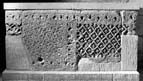
Object type: Slab in three pieces
Measurements:
Dimensions as presently reconstructed:
L. 150 cm (59 in); W. 68.5 cm (27 in); D. c. 28 < 33 cm (11 < 13 in)
a: L. 30 cm (12 in); W. 19 cm (7.5 in); D. 28 cm (11 in)
b: L. 112 cm (44 in); W. 68.5 cm (27 in); D. 33 cm (13 in)
c: L. 28 cm (11 in); W. 17.5 cm (7 in); D. 29.5 cm (11.75 in)
Stone type: The three pieces are of the same type of stone, a pale greyish-yellow (10YR 8/2–3) shell-fragment oolitic limestone, with a micritic or very finely granular groundmass (0.1 to 0.2mm granules) within a mesh of 2 to 3mm shell fragments, together with scattered ooliths of 0.5 to 0.6m diameter. The revealed surface of the middle slab (b) is a bedding plane showing randomly scattered shell fragments and a few flat-lying small Pectinid shells. Bradford stone, Ancliff Oolite Member of Forest Marble Formation, Great Oolite Group, Middle Jurassic
Plate numbers in printed volume: Pls. 407-9
Corpus volume reference: Vol 7 p. 205
(There may be more views or larger images available for this item. Click on the thumbnail image to view.)
Only one face is visible. This is framed by a band of double-stranded triangular knots linked by angular twists (Allen 1903, 291, no. 748 A), enclosed in plain flat bands. The two internal panels are divided by a similar frame. What is now the left-hand panel has a deeply cut diaper pattern in which small relief crosses are enclosed in serrated diamond frames. The pattern on the right-hand panel is now almost obliterated, but earlier photographs (see Ill. 408 and Brown 1937, pl. XLVII) show a complex and rather confused pattern of interlocking and incised peltas.
Although this slab is now set horizontally as if it were part of a shrine, there is some debate as to its function. Irvine (1877, fig. facing 216; see Ill. 409) provides a drawing showing the slab in the upright position decorating the revetment of a door. Baldwin Brown also considered it could be the revetment of a door (Brown 1937, 178, fig. 17), such as one finds at Britford (see below Britford, p. 206), and indeed it might fit the depth of an Anglo-Saxon wall. Brown presumed that this would have come from 'some more pretentious building that was the predecessor of the parish church which is hard by' (see Evidence for Discovery).
Whatever its original function, the decoration is best paralleled in manuscript art. The type of pointed triangular interlace is akin to but not identical with that found at Britford (Ill. 422), but is found also in the Vespasian Psalter (Ill. 527), and according to Romilly Allen (1903, 291–2) this type of triangular interlace is also found in the Book of Kells and a Carolingian gospel book, BL Harley 2788. The peltas with spiral terminals find their only sculptural parallel in England on the font from Deerhurst, Gloucestershire (Bailey 2005, pls. 6–8), but the crosslets in diamond frames are more difficult to parallel. They are most closely akin to a panel on a cross from Irton in Cumbria (Bailey and Cramp 1988, ill. 357), but as Romilly Allen said percipiently, the pattern resembles 'more nearly than anything else the silver plates pierced with cruciform openings that are used in the decoration of the Irish metal book shrines' (Allen 1894, 61). Although the shrines he compared it with are now considered Romanesque in date, patterns of crosslets in stepped frames also occurs on the Emly shrine which has been dated late eighth century (Cone 1977, 137, pl. 31). David Hinton (pers. comm.) has compared the decoration with that of the garnets and millefiori on the Sutton Hoo shoulder clasps (cf. Wilson 1984, ill. 7), in which case it could be of an even earlier date and indeed contemporary with Aldhelm. When painted this piece could indeed have resembled metalwork. Functionally, therefore, although it could have fitted a door opening, it seems more plausible to consider that it was part of a shrine or tomb, which perhaps had been located in the now lost church associated by William of Malmesbury (2002, 236) with St Aldhelm, and that it was not a late revival of Irish influence as suggested by Stone (1955b, 37).
