Select a site alphabetically from the choices shown in the box below. Alternatively, browse sculptural examples using the Forward/Back buttons.
Chapters for this volume, along with copies of original in-text images, are available here.


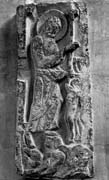
Object type: Slab or panel
Measurements: (after Zarnecki 1984) H. 170 cm (67 in); W. at top 65 cm (25.5 in), at base 76.5 cm (30 in); D. 15 < 24 cm (6 < 9.5 in)
Stone type: A poorly sorted, oolitic, bioclastic, roughtextured, yellowish grey (5Y 7/2) limestone. The matrixsupported ooliths are in the range 0.3 to 1.0 mm diameter and weather out to give 'aero-chocolate' texture. The clasts, which are slightly more abundant than the ooliths (in the proportion roughly 55:45) are mostly elongate, but the smaller ones are sub-rounded to rounded. The shell fragments stand proud to give the panel a rough texture. Bradford stone, Forest Marble Formation, Great Oolite Group, Middle Jurassic
Plate numbers in printed volume: Pl. 198
Corpus volume reference: Vol 7 p. 145-6
(There may be more views or larger images available for this item. Click on the thumbnail image to view.)
The life-size figure of Christ is shown half turned, holding up his right hand with two fingers extended in blessing, and with his left hand he holds a staff rood which touches the hand of a small naked figure reaching towards him. He treads under foot the writhing figure of Satan. His head is inclined, looking down on the figures below, and is surrounded by a large dished halo. His face is moustached and bearded, and his long wavy hair (indicated by wide curving cuts) falls to his shoulders. His features are now rather indistinct, but his eyes are lightly conveyed without pupils. He is wearing a long-sleeved overmantle draped into hard sharp folds, which is pulled round his knee and falls in nested Vshaped folds at the centre. His undergarment has a kickedout hem, which like several other features overlaps the surrounding frame. There are, for example, three other upstretched arms on the frame below Christ's right hand, and extremities of the creature beneath his right foot also overlap the frame, as does the Hell mouth on the bottom right. This is shown as the upper jaw and fang of an open mouth, with the snout and eye of a zoomorphic creature; and within this mouth and under the feet of the tall main figure, Satan is depicted as a smaller, writhing, bound and fettered creature. Christ's left leg is slightly raised to bear down on the head of the figure, whose face is slightly raised as if to bite his heel.
Although this stone was found in use as a coffin lid, this most probably was not its original function. Its taper is not in the right direction for a lid, and it seems reasonable to assume, as have several other commentators, that it adorned the walls of a church in the manner of other large-scale carvings in the later Anglo-Saxon period. The panel has engendered a great deal of commentary (the fullest being Smith 1976) but there is no doubt that the scene depicts the risen Christ holding his cross of Victory and 'harrowing' (plundering) Hell to rescue the imprisoned souls from Satan who is finally conquered and fettered. These events, according to scripture, took place from the time of the Crucifixion, when 'many bodies of the saints which slept arose' (Matthew 27. 52–3); during Christ's three days in the tomb, when 'he went and preached unto the spirits in prison' (I Peter 3. 19); and where the Descent into Hell, the Resurrection and Ascension are explicitly linked: 'Now that he ascended, what is it but that he also descended first into the lower parts of the earth? He that descended is the same also that ascended up far above all heavens' (Ephesians 4. 9–10). Nevertheless Smith notes that 'the Descent into Hell is not recorded as a mystery of faith until the early 6th century, when it appears in a Gallican creed', and in the Apostles' Creed by c. 750 (Smith 1976, 101).
Meditation on these themes begins in the early Commentaries of the eastern fathers (Muñoz de Miguel 1997, 75, 79), and depictions of the theme of the Victory of Christ as linked to the Descent into Hell are found as arly as the eighth-century wall paintings in Santa Maria Antiqua, Rome (Nordhagen 1990, 345–8, figs. 2–3). It is clear that these traditions had been fully absorbed by the Anglo-Saxons by the eleventh century since they are recorded in both Anglo-Saxon poetry and art.
In the poem 'Christ and Satan', which ends the Junius manuscript (Oxford, Bodleian Lib., Junius 11, pp. 213–29), the triumphant event and the release of the souls to their 'homeland' is movingly described. The date of the Junius compilation is cAD 1000, but the poem 'Christ and Satan' could have been produced as early as the late eighth to mid ninth century. The relevant passage reads:
It has been suggested in relation to this sculpture (Zarnecki 1984, 150) that the lower figures shown here are Adam and Eve, as is evident in some other depictions of this scene, but these cannot unambiguously be identified here, although the linking of the themes of resurrection and redemption from the old sin of Adam are commonplace in medieval spirituality. In an eleventh century plaque from Newent, Gloucestershire, the themes of Crucifixion, Resurrection and Judgement are portrayed together, with the Crucifixion on one face and on the other Christ dressed as an ecclesiastic treading down Satan whilst St Michael brandishes a massive sword (Zarnecki 1953c, pls. III, IV). The style however is totallydifferent from the Bristol carving.
In manuscripts of the eleventh century this scene is vividly portrayed, particularly in BL Cotton MS Tiberius C. VI, fol. 14 (Backhouse et al. 1984, cat. 66, pl. XX), and this comparison is developed and supported by Smith (1976, 105) who sees the details of the drapery as more closely akin to fol. 30v of the same manuscript. Zarnecki (1984, 150) has also suggested similarity with the Hereford Gospels (Temple 1976, no. 96, ill. 292). Clearly drawings can achieve a greater flexibility and subtlety of line than stone carving, but the sharp linear V-shaped folds and the swirl that indicates the shoulder of Christ are all characteristics of the late drawings (see for example the Copenhagen Gospels, Royal Lib., G.K.S. 10, 2º, fol. 82v, dated to the late tenth/early eleventh century (Temple 1976, no. 47, ill. 153)).
Depictions of the mouth of Hell as a gaping beasthead occur also in the first half of the eleventh century in depictions of the Last Judgement such as BL Stowe 944, fol. 6v (Temple 1976, no. 78, ill. 248), or a remarkable Quinity in which a bound Satan is acting as a footstool for Christ and is poised just over the open mouth of Hell (Temple 1976, no. 77, ill. 245). Further examples are given in Muñoz de Miguel (1997, 77–8). The knowledge of contemporary painted depictions, whether in manuscripts or wall paintings, seems then to be apparent in this carving.
This depiction of Christ is thus to be seen as invoking the related events of the Resurrection with its offer of salvation to all souls even those in limbo, the Ascension of Christ to his ordained place in which the Father would make his enemies his footstool, and the Last Judgement with the final overthrow of Satan and the judgement of mankind, a theme which became more prominent in Anglo-Saxon art around the first millennium. Finally there is one feature of this carving which emphasises the link between the literary depiction of Satan in the poem from the Junius manuscript and the carving here, namely that Satan is not shown as a bestial creature with wild shaggy hair, as he is from the Book of Kells, fol. 202v (Alexander 1978, ill. 255), to BL Stowe 944, fol. 7 (Temple 1976, ill. 248), but as he is in the poem, a fallen creature who can almost be pitied.
Although carvings such as this are not common in the pre-Conquest period, it is not isolated and it is also very different in the drapery treatment from Romanesque carvings, with which it has sometimes been compared. The context provided by the manuscripts and poetry also supports the suggestion of a pre-Conquest date. The recent discovery of the Congresbury carvings (Ills. 204–20) has provided a good unweathered parallel for the sharp folds and swirling curves of the drapery on this panel (see Ill. 218), as well as an iconographic parallel (to add to the figure of Christ from Beverstone, Gloucestershire (Quirk 1961, 30, pl. VIII.2)) for a standing figure of Christ in blessing holding a staff rood (see Ill. 220). These occurrences suggest that large-scale carvings could have been more common in Wessex than the few survivals might indicate (see introduction pp. 57–61).
