Select a site alphabetically from the choices shown in the box below. Alternatively, browse sculptural examples using the Forward/Back buttons.
Chapters for this volume, along with copies of original in-text images, are available here.


Object type: Part of a slab or shaft
Measurements: L. max. 119 cm (46.75 in); W. 62 < 65 cm (24.5 < 25.5 in); D. max. visible 9 cm (3.5 in)
Stone type: Heavily coated with a plaster wash, but in places, a light grey (N7), poorly sorted, clast-supported, bioclastic limestone with sub-angular to sub-rounded clasts varying from 0.3 to 2.5 mm can be seen. ?Doulting stone, Upper Inferior Oolite Formation, Inferior Oolite Group, Middle Jurassic.[1]
Plate numbers in printed volume: Pls. 1-2
Corpus volume reference: Vol 7 p. 79-80
(There may be more views or larger images available for this item. Click on the thumbnail image to view.)
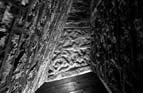
Only one face is visible, edged by wide flat-band mouldings which seem to have a bevelled edge. On the western moulding there are traces of an inscription, including one capital A, which is more visible at the south end but which disappears under the plastered covering at the north (see discussion below). Between the mouldings the surface is filled with a plant-scroll, the stems of which are median-incised. There is a straight central stem and paired tendrils which spring from a triangular node at the base, and an upper node which appears cup-like. The details of the plant forms are so worn that they are difficult to decipher: the lower volutes curve up and inwards, terminating in a trilobed berry bunch and flower with an open cup and pointed pistil. The upper volutes curve up and then fall to intertwine with the strands below, also terminating on the right in a flower with open cup. The pattern on the left (east) side is almost impossible to decipher but does not seem to be a mirror image of the opposite side.
Inscription The two flat bands that define the sculpted area of the visible surface of the slab do not run in parallel and they imply that this was a tapering slab, similar in shape to a plain but inscribed eleventh-century grave-cover at Stratfield Mortimer, Berkshire (Okasha 1971, 114–15, pl. 111; Tweddle et al. 1995, 335–7, ill. 695). At Stratfield Mortimer an inscription runs around all four sides of the upper surface of the slab. It is set within a narrow band defined by parallel incised lines with the tops of the letters pointing outwards towards the edge of the slab. The inscription on the Braunton slab resembles that at Stratfield Mortimer in being set on an edge-band with the tops of the letters facing outwards. Parts of the lettering have plainly been damaged and abraded and it is likely that much of the surviving detail is at present hidden under a skin of plaster or wash. Further lettering at either end of the exposed section of the inscription is probably concealed by the masonry of the window jambs. It is not clear from the photographs whether there could be lettering preserved on the band on the opposite side of the carved decoration. [2] The visible lettering consists of incised capitals. Parts of several letters are traceable in the photographs and the following is a tentative transcription of the more distinct letters:
— [ V . ÆNE . . . . || . . . B . .] —.
The first visible letter looks very much like a plain Roman capital V. There seems to be a vertical after this, perhaps part of I or T. The next letter looks like capital A with a broken cross-bar and a head-bar, which crosses the diagonals before they converge. The left-hand end of the head-bar curls upwards. This 'A' seems to be ligatured with E and so should perhaps be read as æ. The next two letters could be capital N and E. After a space equivalent to perhaps two letters there is a distinct diagonal, perhaps part of capital A or V. No lettering seems to survive around the break in the stone but shortly before the lettering disappears behind the window-jamb there are the remains of what was most probably capital B. This is followed by two verticals. Meaning and even language are uncertain. The Æ, if it is Æ, suggests a text in Old English rather than in Latin. Nearly all examples of Æ in Anglo-Saxon inscriptions appear either in texts in Old English or in Old English names in Latin texts (Okasha 1964–8, table 1a). From what can be seen in the photograph it seems that the letters were plain capitals of Roman forms or variants of them, such as A with a broken ross-bar and head-bar. The visible letter forms are either too indistinct or too standard to be datable but they are compatible with the dating suggested by the carved ornament.
West, in its first modern publication, provided a very accurate rendering of the scroll, although some details, such as the feature top right and the trilobed rather than cup-shaped node at the top, are not evident today (West 1983, 45–6, fig. 10). It is possible that there has been some creature — bird or beast — in the scroll at the top left, but there is no clear shape. Nevertheless West's supposition that the flowers and organisation of the scroll are similar to those on the Cuthbert embroideries (ibid., fig. 12; see Ill. 535) or the border panels of the Cambridge, Corpus Christi MS 183 (Temple 1976, cat. 6, ill. 29; see Ill. 530) is convincing. Within the corpus of sculpture the nearest parallel to this ornament is the grave-cover from the New Examination Schools, Oxford (Tweddle et al. 1995, 234–5, ill. 263). The scroll and its floral elements are cruder in execution than the Devon piece, but it is of interest that the scroll includes a bird, which might support such an interpretation for the features in the upper volutes here. The plant-scrolls on the Colyton shaft (Ills. 3–4) also have some elements in common with this piece, as have the denser and heavier scrolls of the Gloucester (West 1983, pl. XIII) and Bath 7 (Ills. 183–5) grave-covers. This Devon piece is however more tentative than the last mentioned, and one must note that in all the slabs so far discussed there was a slightly coped profile, whilst the Devon slab is flat, so it is an individual piece although within a tradition (see introduction, p. 32).
Most dating of this slab has relied on the comparative dates of manuscripts or of the Cuthbert embroideries, and although there could be some timelag in acceptance of these scrolls into the sculptural repertoire, this piece retains much of the delicacy and openness of the embroidery parallels and should be close in date (see also introduction, p. 54). Higgitt's comparison (above) with the large tapering slab from Stratfield Mortimer provides a parallel for the layout of the inscription and the form, but this is not so precise as to outweigh the evidence for dating of the ornament. It may be of relevance that King æthelwulf made a grant of land at Braunton to Glastonbury Abbey in 839 x 855 (Hooke 1994, 102), and this remained under Glastonbury control until 973, when land at Braunton was exchanged for land nearer to Glastonbury, at High Ham, Somerset (ibid., 115). It is interesting to speculate how this piece came to the extreme west of Devon. The dedication to a Celtic saint and the unusual magnificence, in the region, of the medieval church could indicate that this was an ancient and important site, and this slab may have once covered an important grave, since it is unusual to find pre-Conquest sculpture so prominently displayed in a post-Conquest church.
[1] All stone type identifications in the Devon section of the catalogue are by C. R. Bristow, except where noted.
[2] It has not been possible for me to go to Braunton and examine the inscription since its recent discovery. My comments are therefore based on the photographs and information provided by the Durham CASSS team.
