Select a site alphabetically from the choices shown in the box below. Alternatively, browse sculptural examples using the Forward/Back buttons.
Chapters for this volume, along with copies of original in-text images, are available here.


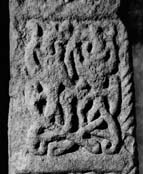
Object type: Incomplete cross-shaft [1]
Measurements: H 164.5 cm (64.8 in); W. 33 > 23.5 cm (13 > 9.2 in); D. 29 > 22.5 cm (11.5 > 8.9 in)
Stone type: As Ilkley (All Saints) 1 but without the quartzite pebbles. This shaft was used as a gatepost with leaded inserts. [J.S.]
Plate numbers in printed volume: Ills. 353-60; Figs. 14, i-j
Corpus volume reference: Vol 8 p. 169-71
(There may be more views or larger images available for this item. Click on the thumbnail image to view.)
A tapering cross-shaft of rectangular section. All the angles are cable-moulded. The panels on faces A and C are divided by flat mouldings.
A (broad): This face has the remains of four panels. The upper part is very worn and the existence of a fifth panel is implied. (i) Collingwood (1915a, 190, fig. e) drew and described two naked human figures, which he identified as Adam and Eve, facing each other, with a feature between which, he said, should be the tree and serpent. The figures certainly face and step towards each other but they apparently grasp two ribbon-like bands which hang between them. The bands end in wedge-shaped terminals. Beneath them is a form that resembles a four-petalled flower. Are these humans or animals? If human there is possibly a figure between them. The legs look humanoid — but not much more so than the legs of the paired adorsed animals in Aiii, though the feet are more convincingly human. However, the creatures in Ai are certainly naked. (ii) The panel below has some wear, at the top and on the left-hand side particularly, and so is not perfectly clear. It has a pair of affronted animals rearing against each other. One foreleg of each is raised parallel to the edge moulding, the others cross between the heads. There are loops around the necks not accounted for in Collingwood's drawing, possibly developing from ear lappets. The lower limbs and tails entwine each other and the animals' lower bodies, though they cannot now be clearly disentangled. The tails cross and end in curled tips at the centre above the lower edge frame of the panel. (iii) This panel is remarkably well-preserved and demonstrates what detail is missing from those above. It has two adorsed rearing quadrupeds, their heads turned back to meet snout to snout in the centre. The heads have long jaws, deeply drilled round eyes and hollow, oval, pointed ears. One foreleg of each, with its three-toed foot, is raised to the outer top corner of the panel, as with the beasts in the panel above. The other drops to rest on the curling tip of the tail. Each animal has a wing which extends to curve round behind its neck, crosses the upper foreleg, passes below the lower foreleg, and ends in a curled tip between the animals, just below the point at which it sprouts. The hind legs have similar three-toed feet. The animals' tails link and pass between their hind legs, ending in a curling tip. A group of three round pellets fills the space between the animals' wings, below their jaws. The carving is sharply defined against a well-dressed background, but the surface of the strands and the animals' bodies is flat with little surface modelling. (iv) The lowest panel is incomplete but is an inhabited bush-scroll with a winged profile bird in each of the three surviving volutes. Each volute of the upper pair ends in a tri- lobed berry bunch, and the stem also ends in a fruit or bud at which the upper pair of birds pecks. These birds have a wing with curling tip which passes under the stem of the volute: the joints of the wing appear to have been outlined. Their legs pass behind the lower curve of the volutes, while their tails pass over them. The birds have round drilled eyes like the animals in the panel above.
B (narrow): This face has a continuous plant-scroll, deeply modelled, with a triple binding at the springing of every volute, from which emerges a tri-lobed flower or berry bunch to fill the spandrel. A hollow pointed or heart-shaped leaf hangs from the outside of every volute. Each volute ends in a flower with three hollow oval petals and one or two berries or loose pellets. Five complete volutes survive, of which the topmost is very worn, and part of another is visible at the bottom.
C (broad): Parts of two panels survive at the foot of this face, both incomplete, the remainder having been cut away in the reuse of this piece as a gatepost. (i) The upper panel has on the left the clawed feet, and on the right part of the broad fantail, of a large bird. The bird's feet rest on a twisted element which lies on the bottom edge of the frame. It is not clear how this relates to the strands which loop between the bird's legs and over its tail, and which end in tri-lobed berry bunches and a pointed berry bunch or leaf, presumably part of a plant. (ii) The lower panel has an animal involved in interlace: the animal is drawn as if seen from above so that both eyes are in the top of its snouted head. One leg extends to the left and appears to be bent upwards, its other limbs are missing or unclear, although one may be supporting it from below. One limb or its tail encircles its body and loops around its neck.
D (narrow): Like face B this has a continuous plant-scroll, of which parts of five volutes survive. There are triple bindings at the springing of the volutes, but the fruit filling the spandrels is a single hollow roundel on a stem. Hollow pointed leaves depend from each volute. Each volute terminates in a triangular berry bunch.
Cramp (1978a, 10) saw this and Ilkley 3 as from a phase during the wars and settlements of the Scandinavian invaders, but in which, in west Yorkshire at least, Anglian iconography and its competence in stone cutting survived. However, based on comparisons of plant-scrolls and animal patterns, this cross seems to be much earlier and the work of the 'Uredale master', the sculptor of the Cundall/Aldborough and Masham shafts (Lang 2001, 43, 93–7, 168–72, ills. 159–84, 597–631). The comparison is particularly convincing in the case of the animal patterns — both the paired animals and those in plant-scroll (see Chap. V, p. 56), although there are points of comparison in the plant-scroll on the sides also (Chap. VII, p. 71). The animal seen from above on Ilkley 2Cii and Cundall/Aldborough 1Ciii is particularly telling in this regard (see Lang 2001, ill. 162).
It is unfortunate that Ilkley 2Ai is so damaged, since if Collingwood is right in seeing this as a scene of two naked human figures, possibly Adam and Eve, this too links it to the other works by the same hand, which include figural scenes among panels of animal, plant or interlace ornament. It is not certain, however, that Collingwood is right, for the lower limbs, though apparently humanoid, are still very similar to those of the paired animals in Aiii. If it is a scene of Adam and Eve, it very likely represents Eve tempting Adam with the apple: in many representations of this scene, the figures face each other across the tree around which the serpent is wound. In scenes in which Adam and Eve have eaten the apple and are hiding their nakedness, they are usually frontal, as on a cross-shaft from Newent in Gloucestershire (Kendrick 1938, pl. LXXVII.1) and, indeed, as on Barwick 2 (see the discussion of Barwick in Elmet 2 and Bilton in Ainsty 4, pp. 95, 100; and Chap. VI, p. 60). However, a possible example of a scene with Adam and Eve facing across the tree is found on a shaft of similar date from Hoddom in Dumfriesshire (Bailey and Cramp 1988, ill. 677).
