Select a site alphabetically from the choices shown in the box below. Alternatively, browse sculptural examples using the Forward/Back buttons.
Chapters for this volume, along with copies of original in-text images, are available here.


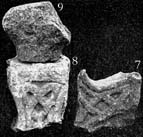
Object type: Fragment of cross-arm [1]
Measurements: (after Collingwood 1915a) H. 18 cm (7 in); W. 19 cm (7.5 in); D. 10 cm (4 in)
Stone type: Not recorded
Plate numbers in printed volume: Ills. 414-5
Corpus volume reference: Vol 8 p. 181
(There may be more views or larger images available for this item. Click on the thumbnail image to view.)
One incomplete arm of a free-armed cross-head of type A10, edged by a flat moulding.
A (broad): The face has an pseudo-interlace formed from two loops, which possibly linked to further ornament on adjacent arms, but may actually have been formed from two linked closed ovals.
B and D (narrow): No surviving illustration
C (broad): The photograph in Brigg (1908, 170, no. 7) shows it was similar to face A.
The form of the head implies an adherence to Anglian tradition, but the large-scale and rather basic pattern element is clearly the simplification of early interlace designs fashionable in the Anglo-Scandinavian period.
