Select a site alphabetically from the choices shown in the box below. Alternatively, browse sculptural examples using the Forward/Back buttons.
Chapters for this volume, along with copies of original in-text images, are available here.


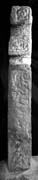
Object type: Incomplete cross-head and -shaft
Measurements:
a (head): H. 40.3 cm (15.9 in); W. 37 cm (14.5 in) across upper arm, 39 cm (15.3 in) across lower; D. 15.5 cm (6.1 in) (upper arm), 17 cm (6.7 in) (lower)
b (shaft): H. 90.7 cm (35.7 in); W. 37.5 cm (14.8 in); D. 18.6 > 17 cm (7.3 > 6.7 in)
Stone type: Medium-grained, poorly sorted ferruginous sandstone. Colour a yellowish brown (10YR 5/6). Local Yoredale cyclothem sandstone, Namurian, Upper Carboniferous. [J.S.]
Plate numbers in printed volume: Ills. 538-40
Corpus volume reference: Vol 8 p. 212-3
(There may be more views or larger images available for this item. Click on the thumbnail image to view.)
A hammerhead cross with curved armpits. The block-like side arms are roughly type A1, the upper arm an exaggerated form of type A10. The shaft is a rectangular slab in form. The carving is roughly and very shallowly hacked, the decoration all line ornament.
A (broad): The cross-head has an encircled centre at the crossing of the upper arm, which suggests that the head may have risen above this originally. The boss is flat, the circle slightly raised. Incised lines extend into the side arms and towards the second crossing below. These meet and slightly cross the incised edge mouldings on the upper arms and around the upper part of the armpit below. The centre of the lower arms is another flat boss with an incised centre set within a shallow circular depression. One volute of a scroll extends into the right arm, and an incised 'scribble' on the left might be an attempt at another volute.
The shaft, below the break, has very worn edges, within which, extending about halfway down the shaft, is a panel with an incised outline which is further divided vertically by three roughly parallel incised lines, the left two of which straggle below the lower border of the panel. The vertical lines provide framing lines for what Collingwood believed was an inscription identifying the cross as the 'cross of St Chad' (CROS SCE CEAÐA). He read the letters starting in the second column, with the base of the letters on the left. Higgitt (1986b, 131) has pointed out, in connection with this cross, that inscriptions with vertically set lines of lettering are very rare on English crosses. Indeed, many of the forms left out are as convincing, or as unconvincing, as those left in, and all can be interpreted as crude D-shapes, and rudimentary spirals or scrolls. The form identified by Collingwood, on the lower left, as a rudimentary tree-pattern could equally be a crude attempt at a step-pattern.
B (narrow): This side of the upper arm of the head may have been plain. The end of the lower arm has a heavy detached spiral. The shaft is divided vertically by an incised line, with shallowly carved forms, possibly volutes of a bush-scroll, on either side.
C (broad): Invisible in its present position, but Collingwood (1915a, 220) reported that no ornament was visible, though he surmised it might have been carved and subsequently weathered.
D (narrow): There is carving on the sides of both the upper and lower arms. The upper looks like a crude scroll or spiral, the lower like a double- circled boss, similar to those on the front. The shaft has a very worn but clearly irregular ornament, either a scroll or perhaps an attempted interlace. The outlines are more deeply hacked on this face than on A, giving an impression of an attempt at modelling.
The hammerhead cross, with its connections with the north-west and southern Scotland (see Chap. IV, p. 42), is found in this area otherwise only as a relief cross on a shaft at Gargrave (no. 1: Ill. 278). It is probable, therefore, that the form was carried to Yorkshire through Norse-Irish influence in the early tenth century. The crudeness of this example implies incompetence in carving rather than a later date: the same incompetence is responsible for the identification of the crudely rendered scrolls as an inscription: in fact they are a debased version of the Anglian plant-scroll motif, and as such have much in common with the 'spiral-scroll school' in Cumbria defined by Bailey (in Bailey and Cramp 1988, 33–8), from the same regions as the occurrence of the hammerhead.
