Select a site alphabetically from the choices shown in the box below. Alternatively, browse sculptural examples using the Forward/Back buttons.
Chapters for this volume, along with copies of original in-text images, are available here.


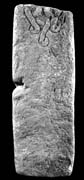
Object type: Lower part of shaft [1]
Measurements: H. 108 cm (42.5 in); W. 39 cm (15.3 in); D. 23 > 18 cm (9 > 7 in)
Stone type: As Burnsall (St Wilfrid) 2
Plate numbers in printed volume: Ills. 109-10; 116-17
Corpus volume reference: Vol 8 p. 110-1
(There may be more views or larger images available for this item. Click on the thumbnail image to view.)
Sub-rectangular in form, a 'round-shaft derivative' of which this is the base, mostly plain.
A (broad): At the top is an incomplete decoration comprising three looped twists forming a pendant triangle. The ornament is grooved, leaving the strands flat against the dressed surface.
B (narrow): There is an incised square near the top. The cable twist above this recorded by Collingwood (1915a, fig. y) is apparent.
C (broad): Much more worn, but appears to be similar to face A.
D (narrow): This has a similar decoration to face A, but with two rather than three looped twists depending from a missing ornament.
This cross-shaft, which is sub-rectangular rather than truly rectangular in form, is most probably a round-shaft derivative of the type with or without a collar, but with a pendant decoration, often called a vandyke, below. These pendant triangles are skeuomorphs of the metal appliqués used to attach metal fittings to wooden poles, as on Irish crozier shrines (Lang 1986, 246–9). There are examples in eastern Yorkshire, on Lastingham 1 and Sherburn 4 (Lang 1991, ills. 574–7, 772–5) and in the North Riding, on Brompton 1 and 2, Gilling West 1, Hawsker 1 and Stanwick 2 (Lang 2001, ills. 30–2, 33–5, 262–5, 319–22, 760–3). Other examples are at Sockburn, nos. 4, 7 and 8, and Dinsdale 1, co. Durham (Cramp 1984, pls. 33.170, 129.707, 134.729, 136.733–6), both sites with hogbacks which have been associated with the Brompton school (Lang 2001, 47). An outlier from this group at Bywell, Northumberland, no. 1 (Cramp 1984, pl. 162.853) has a twisted loop terminating its vandyke which provides the closest parallel to the shaft at Burnsall. The type is widespread and there are examples to the west, for example from Leek, Stafffordshire (Collingwood 1927, 8, fig. 14.10). Lang (2001, 25) took this as confirmation that the model for the Yorkshire round-shaft derivatives was Anglian, and there seems no reason to doubt this ultimate derivation.
Lang (2001, 48) also thought that crosses of this type at Brompton, north Yorkshire, may have served as upright end-stones to hogbacks, as at Penrith, Cumberland (Bailey and Cramp 1988, ills. 494–5). There is too little decoration surviving at Burnsall to determine whether any of the hogbacks was by the same hand, but it is interesting that both types of monument occur at this site. It is possible that the head Burnsall 7 belonged to this shaft, as in Collingwood's reconstruction, but there is no firm evidence either way.
