Select a site alphabetically from the choices shown in the box below. Alternatively, browse sculptural examples using the Forward/Back buttons.
Chapters for this volume, along with copies of original in-text images, are available here.


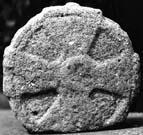
Object type: Incomplete cross-head [1]
Measurements: H. 40.5 cm (16 in); W. 42 cm (16.5 in); D. 12 cm (4.7 in)
Stone type: As Burnsall (St Wilfrid) 7 with quartzite pebbles up to 12mm in size. Rock bleached by ground water to a light grey to very pale brown colour (10YR 7/1–7/3). Traces of pigmentation present (limonite?), colour yellowish brown (10YR 5/4). [J.S.]
Plate numbers in printed volume: Ills. 123-6
Corpus volume reference: Vol 8 p. 112-3
(There may be more views or larger images available for this item. Click on the thumbnail image to view.)
A cross-head of type E8 with plate infill and ring (a).
A (broad): The outer edge of each arm has a flat moulding which echoes the stepped ridge of the ring. The ring, plate and arms are all plain. There seems to have been a shallow boss or circle at the centre of the head.
B and D (narrow): Plain, except for the central ridge of the ring.
C (broad): As face A, except that the centre and the lower part of the head have sustained some damage.
There are plenty of examples of plate-heads and ring-heads in Yorkshire, sometimes at the same site (see for example crosses from Brompton, north Yorkshire (Lang 2001, ills. 51–77), but it is relatively rare to find these two elements combined, especially in such a well-proportioned head. It is more usual to find a crude ring-head where the armpits seem just not have been pierced, as on Finghall 5, north Yorkshire (ibid., 108, ills. 245–9), or Burton in Kendal 4, Westmorland (Bailey and Cramp 1988, 83–4, ills. 193–5, 197). Both these examples are relatively plain, however, and both have been dated tenth to eleventh century. The combined ring- and plate-head type is more common in Ireland, where it occurs as a particular feature in the South Leinster group of granite crosses (Harbison 1992, I, 376–7): see especially the cross-heads from Graiguenamanagh, Newtown, St Mullins and Ullard (ibid., II, figs. 311–14, 524–5, 554, 642–4). In these, the arms are decorated and extend beyond the ring. However the influence of this type in Yorkshire should not be discounted: a group of cross-heads with the Crucifixion scene, mainly in north Yorkshire, seem to have been directly influenced by the same Irish group of crosses (Coatsworth 2000, 167–8). Ring-heads with unpierced armpits are also found in the Isle of Man, and one, from Maughold, has a ring on a cross with similar arms to the Burnsall piece, and is also completely plain (Kermode 1907, pl. XII, no. 39). However, the similarity in proportions of Burnsall (St Wilfrid) 10 to the circle-head type represented by Gargrave 5 (p. 157, Ills. 289–91) should be noted, as influence from this type which also has connections with the north-west of England is possible, and its crested ring links it to the Cumbrian series, such as the example from Muncaster, Cumberland (Bailey and Cramp 1988, 134, ills. 471–5). It also marches with the hogbacks (Burnsall 11–13) and the vertebral ring-chain on Burnsall 1 (Ill. 85), in that it looks westward rather than to Anglo-Saxon types or even Anglo-Danish York. It is therefore a powerful pointer to the 'Hiberno-Norse' connections of Burnsall. In the severity of its plainness, however, it is peculiarly characteristic of this site and no other.
