Select a site alphabetically from the choices shown in the box below. Alternatively, browse sculptural examples using the Forward/Back buttons.
Chapters for this volume, along with copies of original in-text images, are available here.


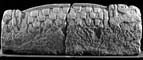
Object type: Hogback, in two joining pieces [1]
Measurements: L. 137 cm (54 in); W. (centre) 23.8 cm (9.3 in); H. (crown) 52 cm (20.5 in); (ends) 48.3 and 41.9 cm (19 and 16.5 in)
Stone type: Sandstone, pale brown (pink stain in places), coarse to very coarse grained, quartz with feldspar, slightly micaceous, kaolinite patches, occasional dark ferruginous speckling. Carboniferous (Millstone Grit Group). [G.L]
Plate numbers in printed volume: Ills. 127-31
Corpus volume reference: Vol 8 p. 113
(There may be more views or larger images available for this item. Click on the thumbnail image to view.)
A hogback with end-beasts, roof ridge, tegulated roof and plain sides (type f).
A (long): Below the ridge are three rows of type 2 tegulation. The end-beasts are stylised and not fully three-dimensional, but they are muzzled. That on the left has an incised circular eye and a prominent ear, that on the right an eye (see face C). Its narrow foreleg is faintly present below the lower jaw, on which Lang (1984, 124) saw beard-like appendages, with no trace of a paw.
B (end): This end has been cut back, perhaps for some reuse. However, both ends are plain.
C (long): As face A, though more worn, with the more complete head on the right.
D (end): Plain
Hogbacks have strong Hiberno-Norse connections and seem to have originated in northern Yorkshire (see Chap. IV, p. 36), with major centres at Brompton and Lythe, both north Yorkshire (Lang 2001, 73–9, 159–66), and Sockburn, co. Durham, where there is a good parallel to the present example in Sockburn 20 (Cramp 1984, 142–3, pl. 145.765–6). It is unusual for the ear to lie at the side of the stone rather than at the top (Lang 1967, 53–3). All the hogbacks from this site are of Lang's 'vestigial' type (1984, 99): see discussion of Burnsall (St Wilfrid) 12.
