Select a site alphabetically from the choices shown in the box below. Alternatively, browse sculptural examples using the Forward/Back buttons.
Chapters for this volume, along with copies of original in-text images, are available here.


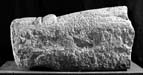
Object type: Part of hogback [1]
Measurements: L. 66 cm (26 in); W. (end) 21 cm (8.3 in); H. (crown) 37 cm (14.5 in)
Stone type: As Burnsall (St Wilfrid) 7 with occasional quartzite pebbles up to 10mm in size. Bedding features parallel to the hogback top. [J.S.]
Plate numbers in printed volume: Ills. 132-6
Corpus volume reference: Vol 8 p. 113
(There may be more views or larger images available for this item. Click on the thumbnail image to view.)
This hogback appears to have been undecorated except for its muzzled end-beast. The ridge is not distinguished and the top and sides are scabbled but otherwise completely plain. The only evident details are the division between the bear's ears, visible on faces D and E, which are plain flat lappets with rounded corners, and the raised band of the muzzle.
See discussion of Burnsall (St Wilfrid) 11. The plainness is characteristic of this site. Lang (1967, 54–5) commented on the lack of naturalism and the fact that details of the bear's head are confined to the top. The only parallel to this example is Burnsall (St Wilfrid) 13, below.
