Select a site alphabetically from the choices shown in the box below. Alternatively, browse sculptural examples using the Forward/Back buttons.
Chapters for this volume, along with copies of original in-text images, are available here.


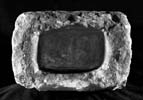
Object type: Part of shaft
Measurements: H. 55.5 cm (21.8 in); W. 29 > 26 cm (11.4 > 10.2 in); D. 20.5 > 17.4 cm (8 > 6.8 in)
Stone type: As Frickley (All Saints) 1.
Plate numbers in printed volume: Ills. 269-73
Corpus volume reference: Vol 8 p. 154-5
(There may be more views or larger images available for this item. Click on the thumbnail image to view.)
An incomplete cross-shaft of rectangular section. The angles on all face are cable-moulded. The background is dressed flat.
A (broad): There are inner roll mouldings on either side. This face has a beautifully formed interlace with a strand of varying width. The surface is dressed back very cleanly around these strands, which are not deeply cut but which are shallowly modelled. One complete and two part registers survive. One strand of the lowest register bifurcates to form a plant-like spiral. Above this is a register formed from a single pattern A loop, filling the full width of the shaft within its borders, and the third register above is an equally large-scale but incomplete loop. The swelling of the strand in the central loop and lower spiral could suggest an animal form, but there is no surviving terminal to confirm this.
B (narrow): A fine stranded interlace as on face C below, a not quite regular version of half pattern F.
C (broad): This very worn face has a large-scale interlace pattern with a fine strand, three registers of half pattern F with outside strands.
D (narrow): A continuous spiral scroll of which three volutes survive. It has plain nodes from which spring single trumpet-shaped leaves. Similarly shaped leaves drop from the outside of the volutes to fill the spandrels, and there are six- or seven-petalled flowers in the centre of the volutes.
E (top): A broad shallow socket, possibly cut for a reuse of the stone, or perhaps a mortise for an upper section or head.
See discussion of Frickley 1 above for the use of large-scale patterns in the late pre-Viking period. Few, however, have patterns so well-cut as that on face A, for which I have not been able to find a satisfactory parallel. There are parallels to face B at, for example, Jedburgh and Whithorn of ninth to tenth century date (Cramp 1983, 283, fig. 121c; Collingwood 1922–3, 216, fig. 12), and a cross-shaft from Whithorn also has single and double twists (Collingwood 1927, 3, fig. 11). Face D compares with Ilkley 4A (Ills. 346, 350), perhaps more than Ilkley 1 and 2 (Ills. 336, 338 and 358, 360). That strand bifurcating into a scroll on face A could be an indication of a slightly later date than Frickley 1.
