Select a site alphabetically from the choices shown in the box below. Alternatively, browse sculptural examples using the Forward/Back buttons.
Chapters for this volume, along with copies of original in-text images, are available here.


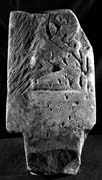
Object type: Lower part of shaft
Measurements: H. 64.5 cm (25.4 in); W. (above tenon) 32.5 > 31.3 cm (12.7 > 12.3 in); D. (above tenon) 14 > 13 cm (5.5 > 5.1 in)
Stone type: As Frickley (All Saints) 1.
Plate numbers in printed volume: Ills. 274-7
Corpus volume reference: Vol 8 p. 155
(There may be more views or larger images available for this item. Click on the thumbnail image to view.)
A cross-shaft of almost slab-like section. It is cut away at the base to form a tenon, and this appears to be original. The side panels and face A are clearly terminated, all with plain areas below the decoration. The edge mouldings, much damaged, appear to have been plain and flat.
A (broad): This has the main surviving decoration: an interlacing of broad and narrow strands, probably animal ornament although no certain head or limb survives. The interlacing includes a very clear loop-like twist on the right-hand side.
B (narrow): This seems to have an inner moulding and within this is the lower termination, probably of a two-strand twist, ending against the lower frame of the panel.
C (broad): Dressed plain, perhaps for a later reuse. There are traces of an edge moulding on the left and possibly the lower edge of a circle or loop near the top.
D (narrow): This has a simple two-strand twist, damaged at the base and on the lower left side.
This is the largest of the four pieces from this site. Its proportions and lack of cabled edging differentiate it from the other three. The animal ornament has some features — such as the twist forming a small loop — in common with other late Anglian sculptures, for example Ilkley 3Cii (Ill. 363). The simple pattern of the sides occurs very early in Anglo-Saxon art, in manuscripts as well as in sculpture, but its use on a large scale to fill a whole face again seems to be a late Anglian simplification.
